Frameworks
Six interconnected concepts that organise the inquiry of Dimensional Ethics Press. Each framework is a lens; together, they form an architecture.
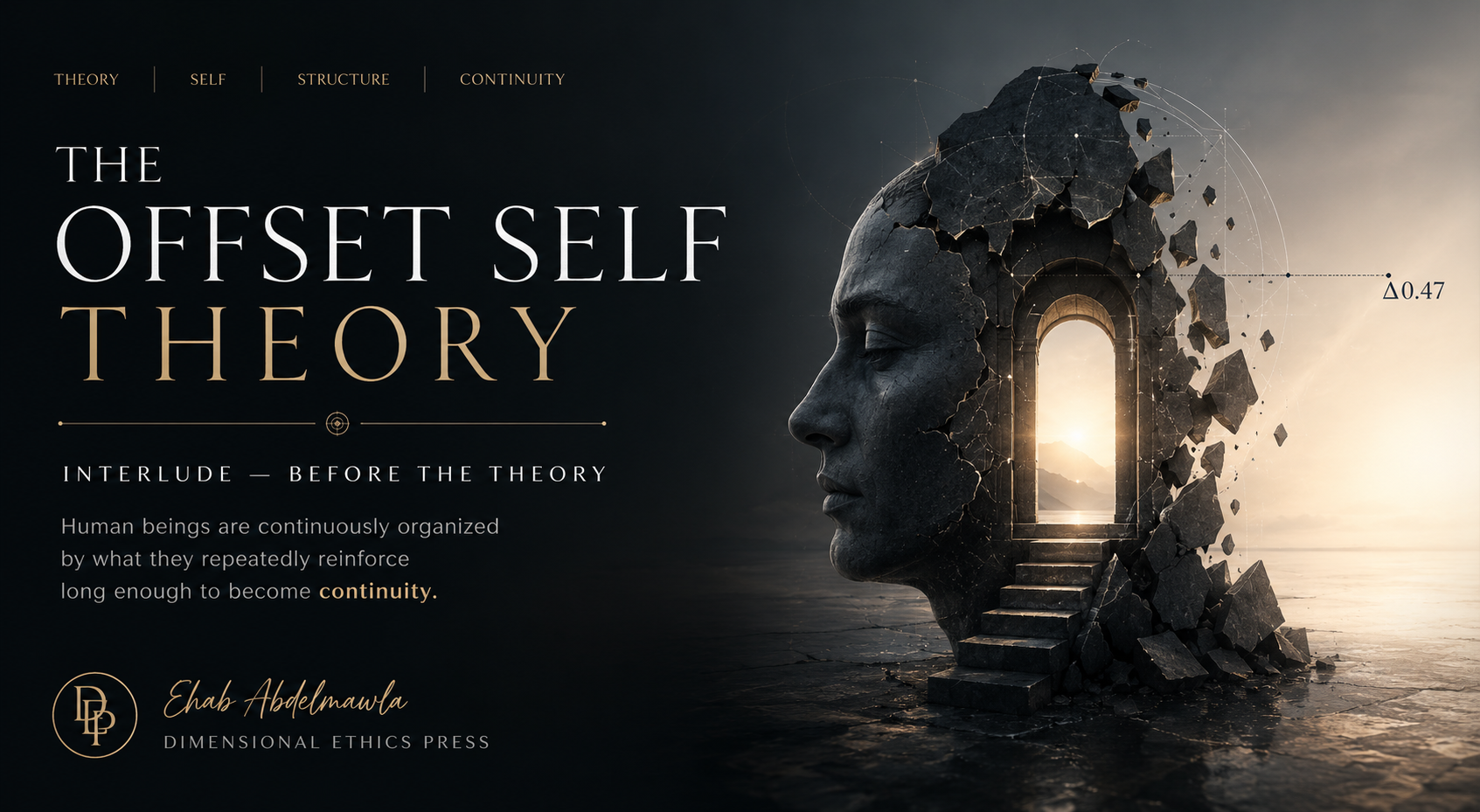
The Offset Self Theory
Interlude — Before the Theory
An exploration of the hidden architecture between who we understand ourselves to be and who our repeated behaviour teaches us to become.
The Equation of Rise and Decline
33 → 5 → 1. How alignment, timing and pressure combine into a single relationship that determines whether a system rises, holds, or declines.
Incentives Shape Systems More Than Intentions
Systems rarely become what they intend to be — they become what they reward. Incentives shape behaviour, culture and long-term outcomes more powerfully than intentions or declarations.
Employment Theatre
The condition in which an organisation gradually becomes better at performing work than producing value — visibility replaces contribution, and activity is mistaken for progress.
The Dimensional Ethics Framework
A unifying lens for thinking about behaviour, consequence, and meaning across the visible and invisible dimensions of human experience.
Systems Thinking
The study of structure, relationship, and feedback — how parts compose wholes, and how wholes behave over time.
Human Behaviour
The patterns of decision, identity, and contradiction that shape what people actually do, regardless of what they claim.
Moral Architecture
The hidden scaffolding of values, incentives, and assumptions that determines which acts are conceivable within a given system.
Consequence and Feedback Loops
The mechanisms by which actions return to their origins — amplifying, dampening, or transforming the systems that produced them.
The Unseen and the Seen
The dialogue between what is observable and what is not — and the ethical weight of the invisible in human affairs.
The frameworks are not separate disciplines. They are facets of a single question: how do unseen structures shape what is seen?
Notes from the press, occasionally sent.
New books, essays, and announcements. No marketing. No noise.