The Organisation Has Two Selves
What a System Says It Is—and What Its Behaviour Reveals It to Be
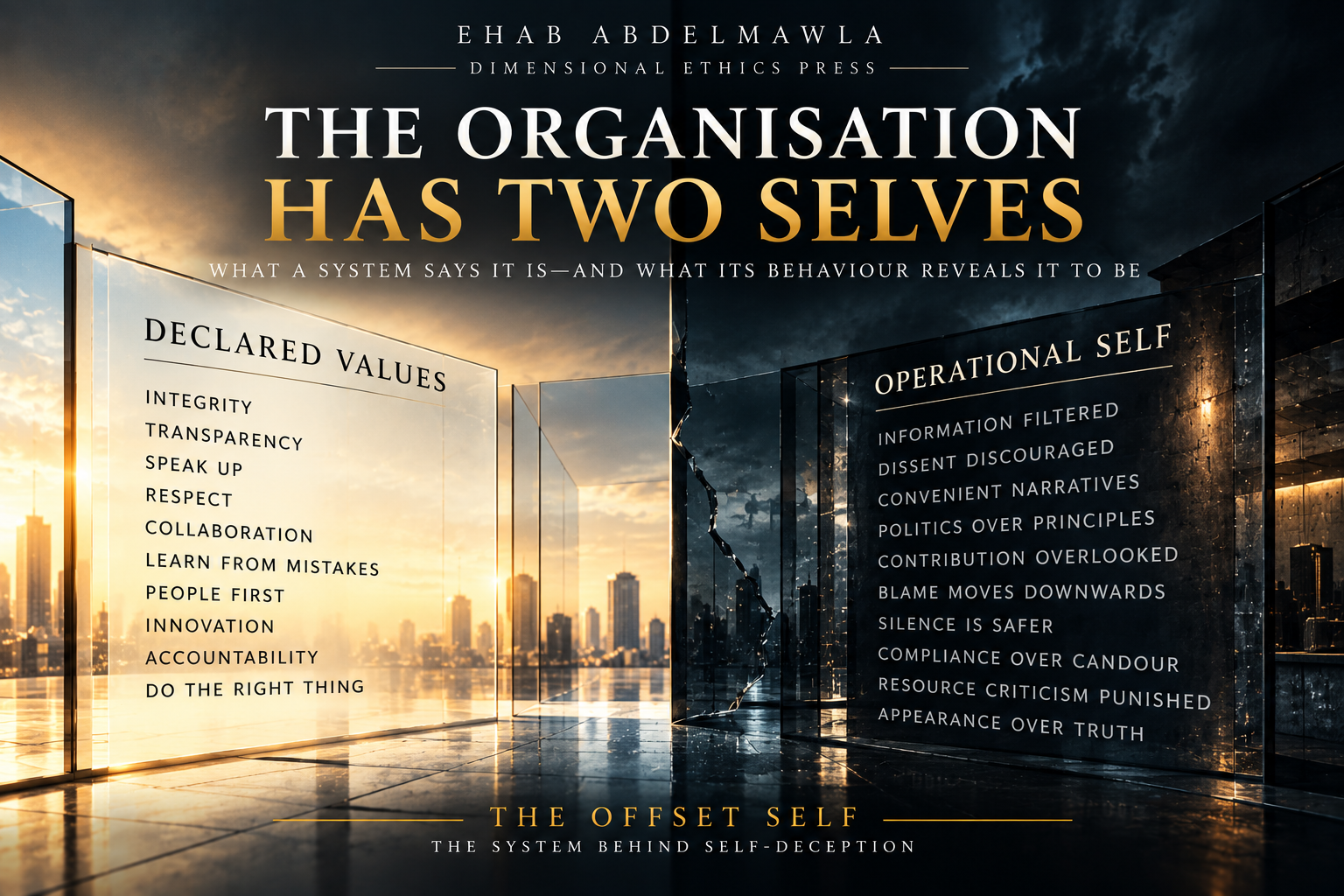
Every organisation has an identity.
Sometimes it is written on walls.
Sometimes it appears in annual reports, leadership presentations, codes of conduct, employee surveys and corporate values.
We value integrity.
We encourage people to speak up.
We put customers first.
We learn from mistakes.
We reward collaboration.
We respect different perspectives.
These statements are not necessarily dishonest.
The people writing them may genuinely believe them. Senior leaders may genuinely want them to be true. Employees may join the organisation precisely because they believe in them.
But an organisation has another identity.
It is rarely written anywhere.
It emerges through thousands of decisions about what gets rewarded, what gets ignored, who gets heard, what gets questioned, which behaviours are tolerated, where resources flow, how disagreement is treated and what happens when someone challenges the prevailing direction.
The first identity is the organisation as it understands itself.
The second is the organisation as it actually operates.
And between them lies an offset.
THE ORGANISATIONAL OFFSET
In The Offset Self: The System Behind Self-Deception, I explore a simple but consequential human phenomenon.
We rarely operate as a single, perfectly aligned self.
There is the person we believe ourselves to be.
There is the person we present to others.
And there is the person revealed through repeated behaviour.
Usually the distance between these identities is small.
But small distances, repeated over time, can produce very different destinations.
The same principle can be applied to organisations.
An organisation may sincerely describe itself as transparent while developing habits that discourage uncomfortable information.
It may describe itself as innovative while rewarding predictability.
It may promote accountability while making accountability personally expensive.
It may encourage challenge while repeatedly advancing those who create the least friction.
It may celebrate collaboration while designing incentives that reward territorial behaviour.
None of these contradictions requires deliberate deception.
That is precisely what makes the organisational offset difficult to see.
The organisation does not need to lie about what it is.
It only needs to mistake its declared identity for its operational identity.
DECLARED SELF AND OPERATIONAL SELF
The declared self is easy to observe.
It exists in policies, values, strategies, leadership speeches, governance structures and organisational language.
The operational self is harder to document because it is distributed across behaviour.
Consider an organisation that says:
We encourage people to speak up.
That statement tells us something about its declared self.
But to understand its operational self, different questions must be asked.
What happens to people who repeatedly disagree?
What happens when uncomfortable information moves upward?
Does the messenger gain credibility—or acquire a reputation for being difficult?
Are problems examined, or is attention redirected toward the behaviour of the person who exposed them?
Do managers welcome challenge when it threatens something they have already promised?
Do employees observe that silence is safer than accuracy?
Those answers reveal something no corporate value statement can reveal.
They reveal the operating identity of the system.
This distinction matters because systems ultimately produce outcomes through their operational identity, not their declared one.
A railway does not move trains according to the diagram displayed in its headquarters.
It moves them according to the tracks that actually exist.
Organisations are no different.
THE SYSTEM MAY BELIEVE BOTH
There is a tempting explanation whenever declared values and actual behaviour diverge.
Hypocrisy.
Sometimes that explanation is correct.
But often it is too simple.
An organisation can genuinely believe two contradictory things at the same time.
Senior leadership can sincerely want transparency.
Middle management can sincerely want stability.
Employees can sincerely want psychological safety.
Governance teams can sincerely want accountability.
Delivery teams can sincerely want speed.
None of those objectives is inherently unreasonable.
Yet when they interact, the resulting system may behave in ways nobody explicitly intended.
Transparency collides with reputation.
Accountability collides with hierarchy.
Challenge collides with delivery commitments.
Safety collides with managerial authority.
Learning collides with the desire to close an issue quickly.
The organisation then develops mechanisms for reconciling these contradictions.
Usually not through conscious design.
Through behaviour.
The uncomfortable meeting becomes shorter.
The difficult question is deferred.
The dissenting voice receives fewer opportunities.
The inconvenient evidence becomes “context.”
The issue is reframed.
The person raising the concern becomes part of the concern.
No single decision necessarily changes the organisation.
But collectively they begin constructing another identity.
The operational self.
THE REAL VALUES OF A SYSTEM
If you want to understand the real values of an organisation, do not begin with the values printed on its website.
Watch what happens when two values collide.
Almost every organisation supports integrity when integrity costs nothing.
Almost every organisation supports transparency when the information is comfortable.
Almost every organisation supports innovation when experimentation succeeds.
Almost every organisation supports speaking up when the speaker confirms what leadership already suspects.
The system reveals itself when there is a price.
Integrity versus reputation.
Transparency versus authority.
Challenge versus harmony.
Safety versus delivery.
Evidence versus hierarchy.
Long-term resilience versus short-term performance.
That is where the operational hierarchy of values becomes visible.
The question is therefore not:
What does the organisation value?
A better question is:
When two declared values cannot both survive, which one does the system repeatedly protect?
The answer may reveal more about organisational culture than a thousand employee surveys.
BEHAVIOUR CREATES POLICY WITHOUT WRITING IT
Not every organisational rule appears in a policy.
Some of the most powerful rules are learned through observation.
Employees notice who gets promoted.
They notice who gets invited.
They notice whose mistakes disappear quietly.
They notice whose mistakes become memorable.
They notice which questions create discomfort.
They notice when challenging a decision leads to more scrutiny than making the decision itself.
They notice when someone speaks openly and what happens afterward.
Eventually employees begin adjusting.
Nobody needs to send an email saying:
Do not challenge this.
The system teaches the rule without writing it.
Nobody needs to announce:
Protect your manager’s narrative.
People learn which narratives are safe.
Nobody needs to say:
Keep difficult information away from senior leadership.
People learn what happens to those who carry difficult information upward.
This is how culture becomes architecture.
Repeated consequences transform observations into expectations.
Expectations transform into behaviour.
Behaviour reproduces the system.
And eventually the organisation may look at the resulting silence and conclude:
There appear to be no serious concerns.
The system has mistaken the absence of visible resistance for the absence of resistance itself.
SUCCESS CAN WIDEN THE OFFSET
Organisational offsets do not necessarily emerge because organisations are failing.
Sometimes success creates them.
A successful team develops confidence in its methods.
Confidence becomes certainty.
Certainty reduces curiosity.
Past success becomes evidence that existing structures work.
Challenges begin to look less like information and more like disruption.
The system gradually becomes better at defending the architecture that produced yesterday’s success than examining whether that architecture still serves tomorrow.
This is one reason organisational decline can begin while conventional performance indicators still look healthy.
The system may still be delivering.
The dashboards may remain green.
Targets may still be met.
Leadership may still be confident.
Yet the distance between declared identity and operational reality can quietly increase.
The organisation has not collapsed.
It has drifted.
And drift is dangerous precisely because it rarely announces itself.
THE MIRROR PROBLEM
Human beings have mirrors.
Organisations have dashboards.
Neither necessarily shows what matters.
Most organisational measurement systems are designed around what can be counted.
Delivery.
Revenue.
Incidents.
Complaints.
Employee engagement.
Operational performance.
Risk.
Productivity.
These measures are valuable.
But an organisational offset often exists between measurements.
How many people stopped raising concerns after watching what happened to someone else?
How many ideas disappeared because employees predicted resistance?
How many risks were softened before reaching senior leadership?
How many disagreements were resolved through silence rather than agreement?
How many capable people learned that contribution was less important than alignment with authority?
How many decisions were technically compliant but behaviourally corrosive?
These are difficult things to place on dashboards.
Yet they shape the organisation continuously.
The absence of measurement does not mean the absence of effect.
It means the effect has become harder to see.
WHEN THE OFFSET BECOMES NORMAL
A small gap between declared identity and operational identity is probably unavoidable.
No organisation perfectly embodies its values.
The danger begins when the system stops detecting the gap.
Then contradiction becomes routine.
Routine becomes culture.
Culture becomes expectation.
Expectation becomes structure.
Eventually employees no longer experience the contradiction as unusual.
They simply learn how things work.
A new employee may initially ask:
“Why do we do this?”
Six months later:
“This is how we do it.”
Two years later:
“This is how it has always been done.”
At that point the offset has become institutional memory.
The organisation may continue describing itself using values that were once aspirational, while everyday behaviour has constructed something entirely different underneath them.
The declared self survives.
The operational self governs.
THE DANGER OF SELF-DECEPTION
Self-deception in organisations is particularly powerful because organisations do not possess a single consciousness.
No individual needs to understand the entire contradiction.
One department owns the policy.
Another owns delivery.
Another owns risk.
Another manages people.
Another measures performance.
Another investigates complaints.
Each component may function reasonably when examined independently.
The distortion becomes visible only when the pieces are viewed together.
This creates a peculiar form of institutional innocence.
Everyone can truthfully say:
I followed the process.
And the system can still produce an outcome that contradicts its stated principles.
That is why organisational self-deception cannot always be solved by finding a bad actor.
Sometimes there is no mastermind.
There is only an architecture producing consequences that nobody individually owns.
THE MOST IMPORTANT QUESTION
Organisations spend enormous effort asking employees whether they understand corporate values.
Perhaps organisations should spend more time asking a different question:
What would an independent observer conclude our values are if they could see only our repeated behaviour?
Not our website.
Not our strategy.
Not our policies.
Not our presentations.
Only behaviour.
What gets rewarded?
What gets protected?
What gets questioned?
What gets ignored?
Who gets heard?
Who learns to remain silent?
Where does information stop?
What happens when evidence threatens authority?
What happens when doing the right thing becomes inconvenient?
Those answers reveal the organisational self that actually interacts with the world.
THE OFFSET IS NOT THE FAILURE
The existence of an offset does not necessarily mean an organisation is unhealthy.
Every human system contains contradiction.
The real danger is losing the ability to see it.
An organisation capable of detecting the distance between what it believes and how it behaves can still correct course.
An organisation that cannot see that distance begins protecting the gap itself.
Feedback becomes threat.
Challenge becomes disloyalty.
Contradiction becomes something to explain rather than investigate.
And eventually the system becomes highly skilled at demonstrating that its declared identity still exists.
Policies remain.
Values remain.
Surveys remain.
Governance remains.
The language remains.
Only the behaviour has moved.
That may be one of the most consequential forms of organisational drift because nothing appears to have changed.
Yet almost everything has.
The organisation still recognises itself in the mirror.
It simply does not realise that the mirror is showing the person it remembers being.
THE OFFSET SELF
The idea behind The Offset Self begins with the individual, but perhaps it does not end there.
People construct identities.
Teams construct identities.
Institutions construct identities.
Entire systems construct identities.
And in every case, the most important question may not be:
Who do we believe we are?
It may be:
How far is the person—or system—we believe ourselves to be from the one our repeated behaviour is quietly constructing?
Because the gap may begin small.
Almost invisible.
A decision here.
An exception there.
A silence.
A compromise.
A behaviour tolerated once and then tolerated again.
But systems rarely arrive somewhere different because of one enormous decision.
They drift there through thousands of small ones.
The gap is small.
The consequences are not.
— Ehab Abdelmawla The Offset Self: The System Behind Self-Deception Dimensional Ethics Press
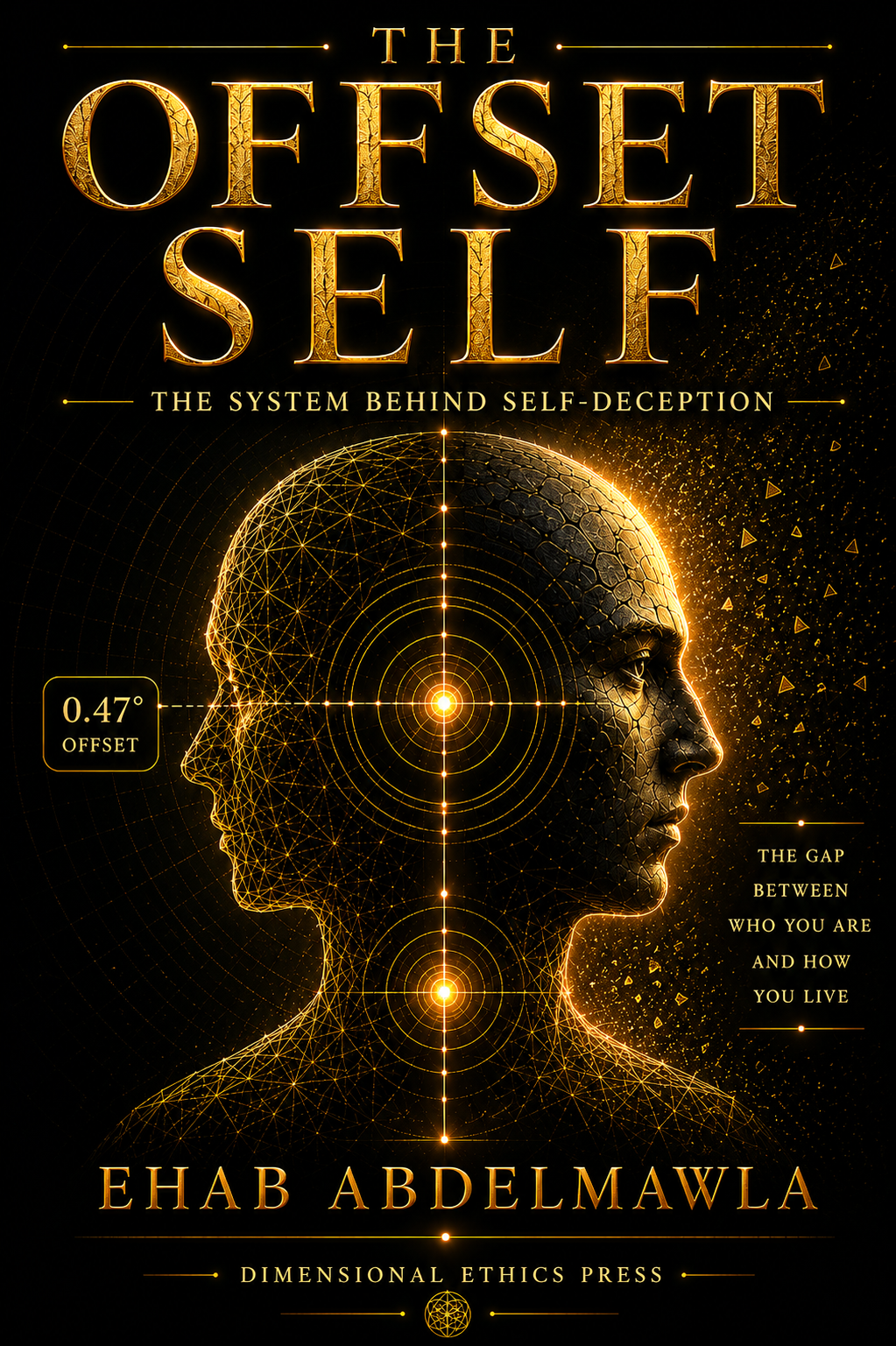
The idea behind The Offset Self begins with the individual, but perhaps it does not end there. People construct identities. Teams construct identities. Institutions construct identities. Entire systems construct identities.
Explore The Offset Self →Ehab Abdelmawla
Author • Founder of Dimensional Ethics Press
Exploring hidden systems, consciousness, human behavior, history, and the unseen structures shaping reality.
Author profile →Related Articles

The Smallest Gap Can Shape an Entire Life
How small deviations today become the distance we live tomorrow.

The Three Selves You Carry Every Day
Most people believe they have only one self. The truth is more unsettling: we carry three—and the one making our decisions is not always the one we think.
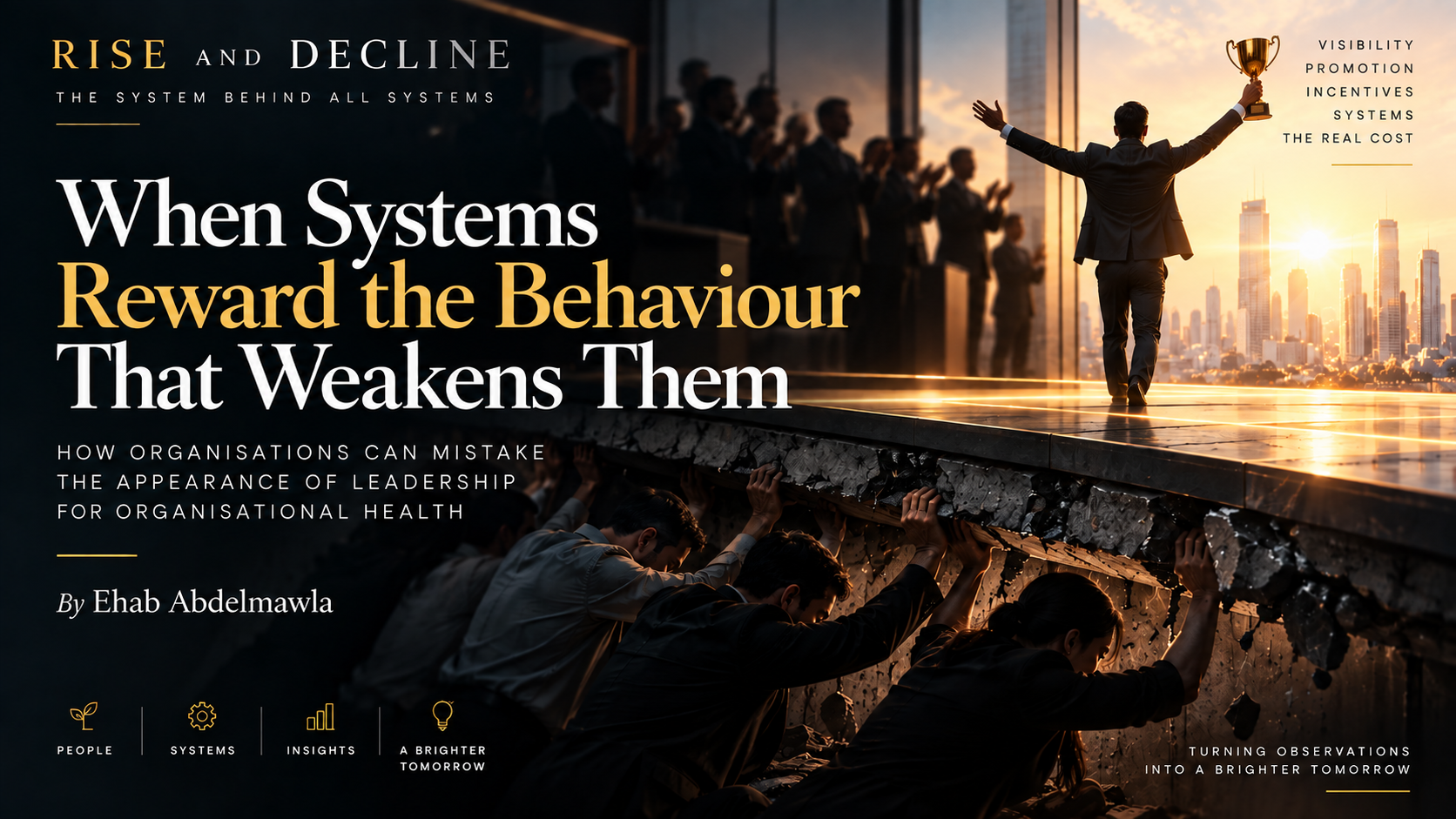
When Systems Reward the Behaviour That Weakens Them
How organisations can mistake the appearance of leadership for organisational health
Every question opens another.
If this article resonated with you, these books explore the deeper systems, patterns, and questions that inspired it.

Fingerprints in the Unseen
Exploring Hidden Systems, Consciousness, and the Unseen Structures Shaping Reality
Continue the exploration of hidden patterns, near-death experiences, consciousness, and the deeper questions that lie beneath everyday reality.
Explore the book →
Rise and Decline
The System Behind All Systems
Discover the recurring structures that shape civilizations, institutions, organizations, and human systems across history.
Explore the book →The Offset Self
The System Behind Self-Deception
Explore the hidden mechanisms that create the gap between what we know, what we intend, and what we actually do.
Explore the book →