When Systems Reward the Behaviour That Weakens Them
How organisations can mistake the appearance of leadership for organisational health
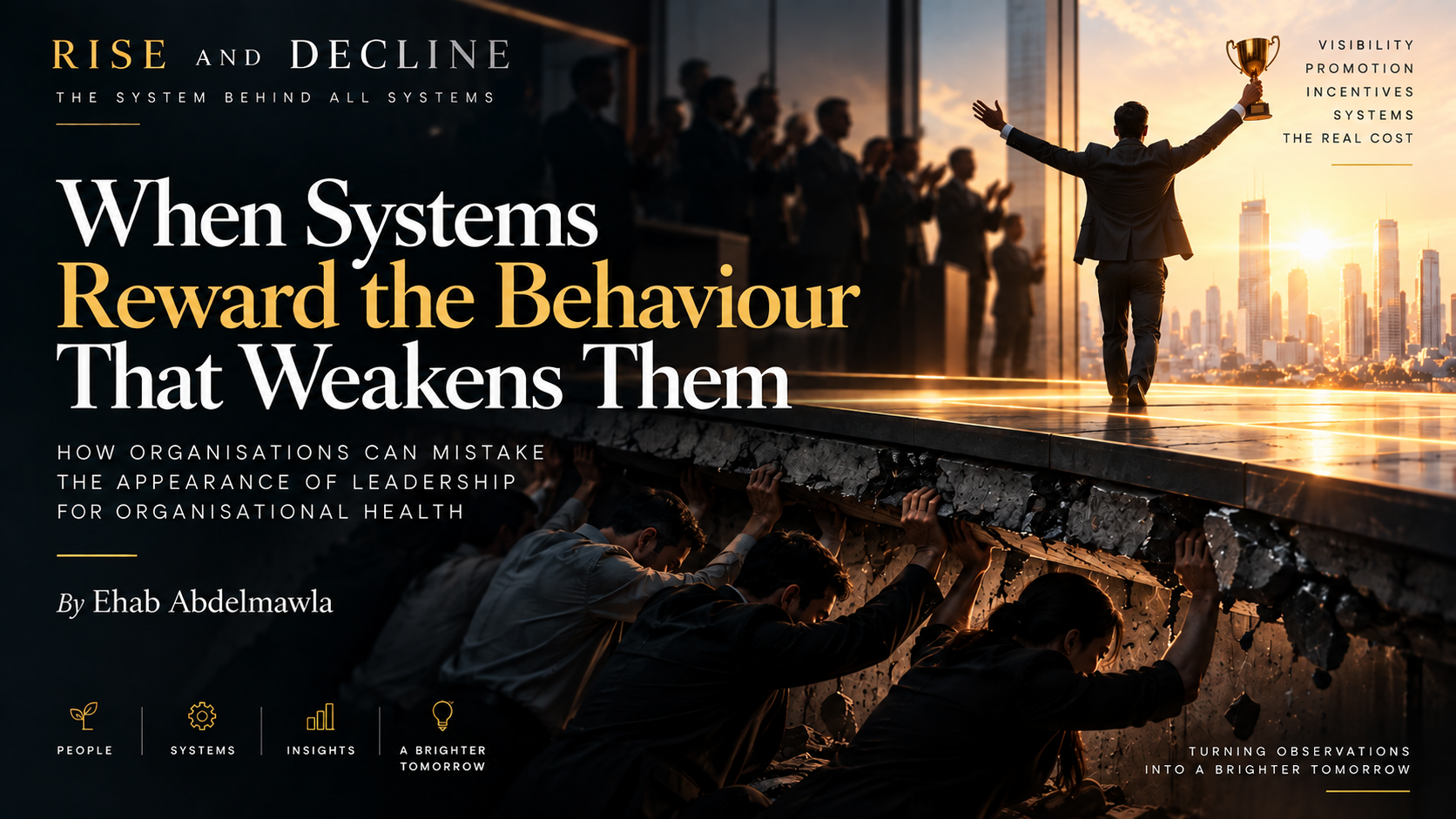
Sometimes poor leadership is not overlooked by the system.
Sometimes it is produced by it.
Protected by it.
Rewarded by it.
And occasionally, promoted by it.
This seems contradictory.
Why would an organisation reward behaviour that increases friction, weakens trust, suppresses capable people, distorts information or creates unnecessary dependency?
The answer is uncomfortable:
Because organisations cannot reward what they cannot see.
And what is easiest to see is not always what matters most.
Headcount is visible.
Activity is visible.
Presentations are visible.
New initiatives are visible.
Escalations are visible.
Expansion is visible.
Executive exposure is visible.
But trust is harder to see.
Prevented problems are harder to see.
The employee who stopped contributing ideas is harder to see.
The capable person whose operating space has gradually narrowed is harder to see.
The team that has learned not to challenge its manager is harder to see.
The unnecessary friction created every day is harder to see.
And the organisation can therefore make a profound mistake:
It can reward the appearance of leadership while accumulating the consequences of poor leadership underneath it.
The Visibility Problem
Every organisation operates through imperfect information.
Senior leaders cannot observe every interaction.
They cannot attend every team meeting.
They cannot see every decision.
They cannot experience every conversation.
They cannot know why someone stopped speaking.
They cannot easily distinguish genuine alignment from reluctant compliance.
So they rely on signals.
Metrics.
Reports.
Presentations.
Delivery updates.
Escalations.
Headcount.
Roadmaps.
Stakeholder feedback.
Management narratives.
This is necessary.
Large organisations could not function otherwise.
But it creates a structural vulnerability.
The people responsible for managing part of the organisation often also play a significant role in explaining that part of the organisation upward.
The manager is therefore not merely operating the system.
The manager may also become one of its principal interpreters.
And when interpretation travels upward more easily than experience, appearance and reality can begin to separate.
Visible Leadership and System Health Are Not the Same Thing
Consider a manager whose area is becoming larger.
More people report into the function.
More initiatives pass through it.
More problems require management attention.
More decisions require approval.
More escalations reach the manager.
More resources appear necessary.
From a distance, this can look like increasing organisational importance.
Perhaps it is.
But there is another possibility.
What if some of that complexity has been created by the way the function operates?
What if decisions that could have been distributed have been centralised?
What if capable people have less autonomy than they could reasonably exercise?
What if information travels through unnecessary gateways?
What if work accumulates because allocation is inefficient?
What if problems repeatedly require escalation because people lack authority to resolve them earlier?
Then organisational activity increases without organisational capability necessarily increasing with it.
This gives us an important distinction:
Visible managerial activity ≠ organisational health
A busy management system is not necessarily an effective management system.
Sometimes the amount of management required is itself evidence that the underlying architecture is weak.
The Indispensability Illusion
One of the most misleading signals inside organisations is indispensability.
A manager appears to be involved in everything.
Important decisions require their input.
Stakeholders constantly need them.
Problems wait for them.
Their absence creates difficulty.
They know information nobody else knows.
They become the centre through which work moves.
From one perspective, this looks impressive.
The organisation depends heavily upon them.
But dependence is not always evidence of leadership strength.
Sometimes it is evidence of structural weakness.
A resilient leader should create capability that continues operating without constant intervention.
Knowledge should spread.
Decision rights should become clearer.
People should develop judgement.
Relationships should exist beyond one individual.
The system should become stronger than the person operating it.
This produces a paradox:
A manager can appear increasingly valuable precisely because the system around them has become increasingly dependent.
The organisation may then reward the dependency rather than question why it exists.
When Problems Increase Importance
There is an even stranger organisational dynamic.
Problems create opportunities for leadership visibility.
A backlog requires attention.
An escalation requires intervention.
A struggling function requires resources.
A conflict requires management.
A delivery problem requires executive engagement.
Solving genuine problems is obviously part of leadership.
But systems must distinguish between two very different things:
Solving complexity.
and
Becoming important because complexity exists.
Those are not equivalent.
If organisational status increases when problems become larger, persistent problems can unintentionally acquire value.
Nobody needs to consciously create them.
The incentive is enough.
This is one of the central arguments of Rise and Decline:
Systems do not become what they intend to be. They become what their incentives repeatedly reward.
If organisational visibility follows complexity, people learn to manage visibility through complexity.
If additional resources follow backlog, backlog becomes consequential.
If authority follows escalation, escalation increases managerial relevance.
If promotion follows organisational expansion, expansion becomes personally valuable.
The system may still believe it is rewarding leadership.
But it may actually be rewarding the conditions that make leadership appear necessary.
The Promotion Paradox
This leads to what we might call the Promotion Paradox:
A system can reward a manager for managing conditions that the manager’s own operating model may have helped create.
The word may matters.
Not every problem is created by management.
Not every expanding team is inefficient.
Not every request for additional resources is unjustified.
Not every centralised decision is unnecessary.
The point is structural.
If the organisation measures the response without examining the conditions producing the problem, it cannot reliably distinguish leadership effectiveness from leadership activity.
Consider the loop:
Centralisation → Dependency → Bottleneck → Management Intervention → Increased Visibility → Greater Authority → More Centralisation
Every stage can appear reasonable.
Nobody needs to manipulate anything.
Yet the system becomes progressively more dependent upon the architecture producing the problem.
And eventually, the person at the centre of that architecture may appear uniquely capable of managing it.
Leadership Externalities
Economics gives us a useful concept: the externality.
An externality occurs when the cost of an activity is borne somewhere other than where the benefit is received.
Leadership can create externalities too.
A manager may receive the visible benefit of a decision while the organisation absorbs its less visible cost.
Centralisation may increase managerial control.
The team absorbs slower decisions.
Aggressive performance pressure may improve a short-term metric.
The organisation absorbs burnout and turnover.
Restricting disagreement may produce smoother meetings.
The organisation absorbs weaker feedback.
Controlling stakeholder communication may create message consistency.
The organisation absorbs reduced cross-functional relationships.
Keeping strong people dependent may preserve managerial importance.
The organisation absorbs lost capability.
Each decision can therefore look rational from one position while weakening the wider system.
This is why Rise and Decline treats alignment as more than achieving immediate outcomes.
The question is not simply:
Did the decision work?
It is:
What did the decision make stronger, and what did it quietly make weaker?
The Hidden Balance Sheet
Financial systems have balance sheets.
Leadership should have one too.
On one side would sit the visible outputs:
Delivery.
Initiatives.
Headcount.
Resources.
Projects.
Presentations.
Milestones.
Escalations resolved.
On the other side would sit the less visible organisational liabilities:
Lost trust.
Reduced autonomy.
Suppressed disagreement.
Unnecessary dependency.
Information bottlenecks.
Capability that was never developed.
Ideas that were never raised.
Strong employees who disengaged.
People who left.
Risks that remained invisible because nobody wanted to surface them.
The problem is that most organisations measure the first side much more effectively than the second.
So the balance sheet looks healthy.
Until the hidden liabilities mature.
Then the organisation is surprised by turnover.
Surprised by cultural problems.
Surprised by operational weakness.
Surprised by failed transformation.
Surprised that nobody challenged an obviously poor decision.
Surprised that a critical function cannot operate effectively without one person.
The decline appears sudden.
It rarely is.
The cost was accumulating long before it became visible.
When Competence Becomes Expensive
This connects to another systems problem.
Poor leadership does not affect everyone equally.
Highly independent people often encounter the weakness first.
They need less supervision.
They ask more questions.
They develop relationships independently.
They identify structural problems.
They may challenge assumptions simply by producing differently.
A strong leader converts that capability into organisational capacity.
A weaker system may experience it as friction.
Then something damaging happens.
The organisation continues paying for the person’s competence while gradually reducing its ability to use it.
Their operating space narrows.
Their ideas travel less freely.
Their independence becomes inconvenient.
Their contribution becomes more controlled.
Eventually the individual adapts.
They become quieter.
More cautious.
More transactional.
Or they leave.
From the organisation’s perspective, this may initially look like an individual problem.
From a systems perspective, it is a capability loss.
And capability losses compound.
The People Watching
The greatest cost of poor leadership may not be what happens to the person experiencing it.
It may be what everyone else learns from watching.
Organisations teach constantly.
Not through training.
Through consequences.
People notice who receives opportunities.
They notice who gets heard.
They notice who receives credit.
They notice what happens to disagreement.
They notice whether problems can be raised safely.
They notice whether strong performers are expanded or contained.
And most importantly:
They notice who gets promoted.
A promotion is never merely a transaction between an organisation and one employee.
It is an organisational signal.
It tells everyone watching:
This is what advancement looks like here.
That signal can be more powerful than any values statement.
Promotion Is Replication
This is where the consequences become systemic.
When an organisation promotes someone, it does more than increase that person’s authority.
It increases the reach of their operating model.
Their assumptions travel further.
Their management behaviours affect more people.
Their approach to information becomes more influential.
Their interpretation of performance gains legitimacy.
Their incentives become embedded at a larger scale.
Promotion therefore functions as a form of organisational replication.
This creates another sequence:
Behaviour → Reward → Imitation → Normalisation → Culture
People are adaptive.
If a particular behaviour repeatedly produces advancement, others learn.
Some imitate it consciously.
Others simply adjust.
Eventually what began as an individual’s management style becomes part of the organisation’s operating culture.
This is why rewarding poor leadership is more dangerous than tolerating it.
Tolerance allows the behaviour to remain.
Reward teaches the system to reproduce it.
Values Cannot Compete With Consequences
Most organisations have excellent values.
Collaboration.
Integrity.
Courage.
Respect.
Innovation.
Accountability.
Transparency.
These words matter.
But they cannot override contradictory incentives indefinitely.
Imagine an organisation that says:
Speak up.
But people who challenge decisions experience consequences.
The real instruction becomes:
Be careful.
Imagine an organisation that says:
Innovate.
But deviation from established thinking creates friction.
The real instruction becomes:
Stay within the pattern.
Imagine an organisation that says:
Develop people.
But managers who accumulate dependency receive greater recognition.
The real instruction becomes:
Become indispensable.
Employees eventually learn the difference between declared values and operational values.
Declared values appear on walls.
Operational values appear in consequences.
And when the two conflict, consequences usually win.
The Equation of Decline
In Rise and Decline, alignment can be expressed as:
Alignment = Direction × Incentives × Structure × Adaptation × Feedback
Poor leadership can damage every component.
Direction becomes distorted when personal objectives diverge from organisational objectives.
Incentives reward visible activity rather than systemic health.
Structure becomes unnecessarily dependent on individuals.
Adaptation declines because disagreement and experimentation become costly.
Feedback deteriorates because information becomes filtered through hierarchy.
The organisation may continue functioning.
It may even appear successful.
That is what makes decline dangerous.
Systems rarely collapse the moment they become misaligned.
They often continue producing results while consuming the conditions that made those results possible.
Trust.
Capability.
Institutional knowledge.
Independent judgement.
Honest feedback.
Eventually, the reserves run out.
The Question Above Every Promotion
Perhaps organisations should ask a different question before expanding someone’s authority.
Not simply:
What has this person delivered?
But:
What happens to systems around this person?
Do capable people become more capable?
Does information travel more freely?
Does the team become increasingly resilient?
Can people disagree without disproportionate consequences?
Does knowledge spread?
Does decision-making improve?
Does the function become less dependent upon individual personalities?
Do strong people remain engaged?
Does the organisation become easier to operate?
Or does authority accumulate while capability around it contracts?
Those questions are harder to place on a dashboard.
But they may reveal far more about leadership.
What the System Chooses to Reproduce
Every organisation eventually becomes a reflection of what it repeatedly rewards.
Not what it announces.
Not what it intends.
Not what appears in its leadership framework.
What it rewards.
If people gain authority by developing others, people will develop others.
If people gain authority by sharing information, information will spread.
If people gain authority by encouraging challenge, challenge becomes safer.
If people gain authority by building resilient teams, resilience multiplies.
But the reverse is equally true.
If dependency produces importance, dependency will grow.
If controlling information produces authority, information will become controlled.
If organisational politics produces advancement, political behaviour will spread.
If suppressing challenge carries no cost, silence will become rational.
This is how leadership behaviour becomes system architecture.
And this is how organisations can decline while believing they are rewarding success.
The deepest question is therefore not:
Who deserves promotion?
It is:
What behaviour does this decision teach the organisation to reproduce?
Because culture is not created primarily by values.
Culture is created by consequences.
Watch who receives authority.
Watch what behaviour preceded it.
Watch what everyone else learns from the decision.
Because every promotion is more than a personnel decision.
It is a message from the system about what the system intends to become.
This article develops ideas from Rise and Decline — The System Behind All Systems by Ehab Abdelmawla. Rise and Decline explores how incentives, structure, adaptation, feedback, pressure and timing shape the behaviour of organisations and determine whether systems strengthen themselves—or gradually begin rewarding the behaviours that weaken them.
Explore Rise and Decline →Ehab Abdelmawla
Author • Founder of Dimensional Ethics Press
Exploring hidden systems, consciousness, human behavior, history, and the unseen structures shaping reality.
Author profile →Related Articles
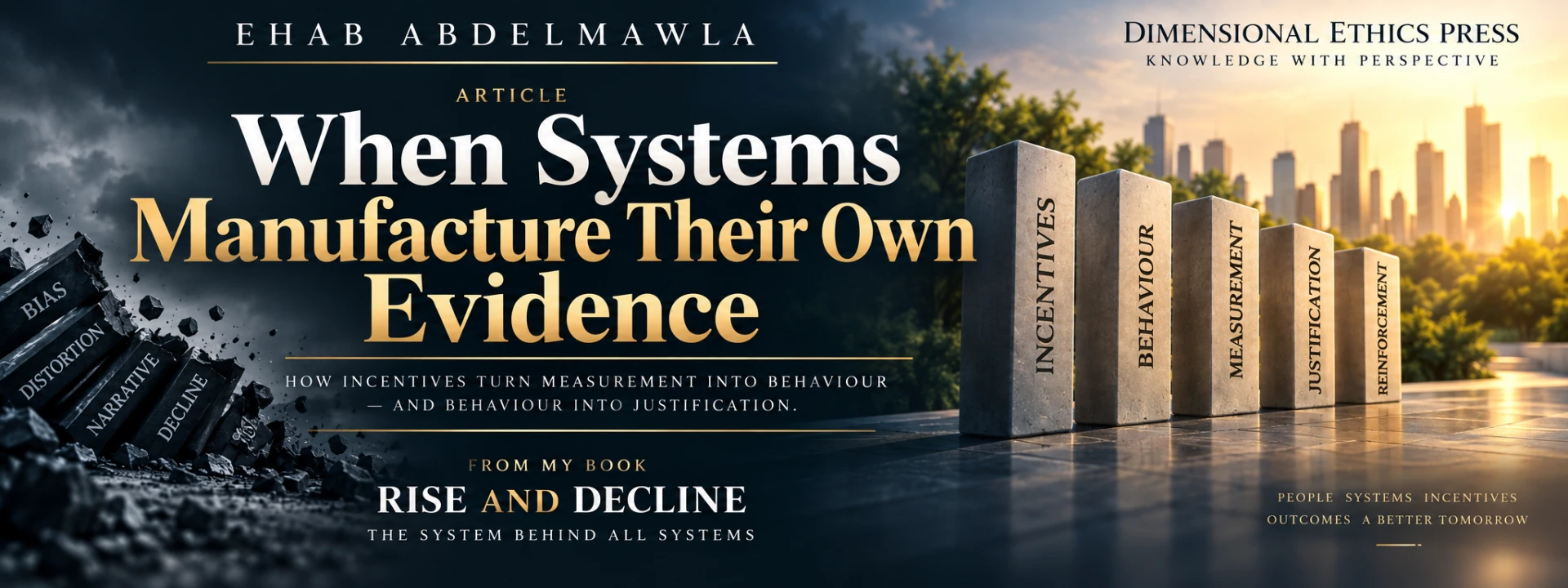
When Systems Manufacture Their Own Evidence
How incentives turn measurement into behaviour — and behaviour into justification.
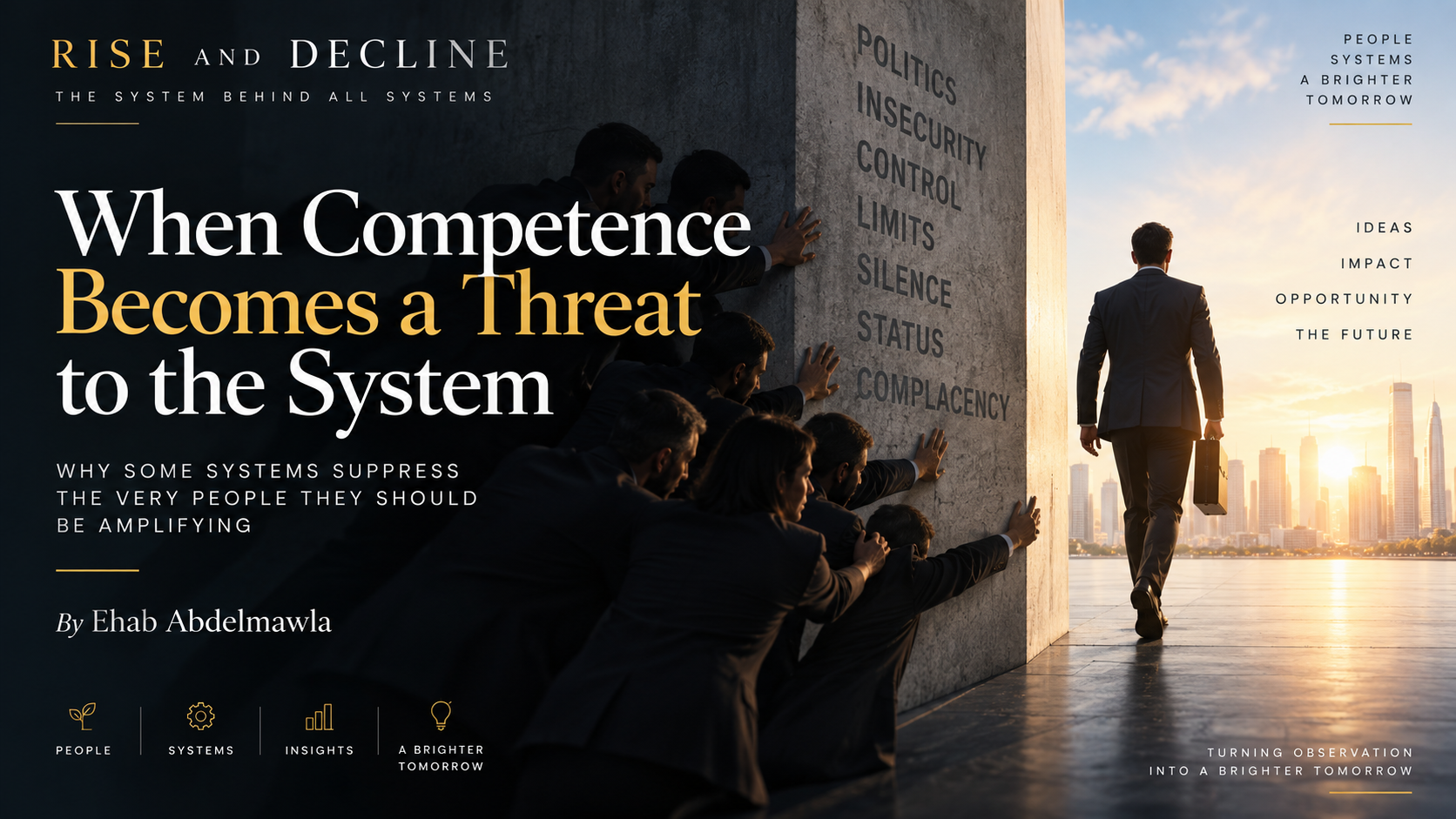
When Competence Becomes a Threat to the System
Why some systems suppress the very people they should be amplifying
Incentives Shape Systems More Than Intentions
Systems rarely become what they intend to be. They become what they reward.
Every question opens another.
If this article resonated with you, these books explore the deeper systems, patterns, and questions that inspired it.

Fingerprints in the Unseen
Exploring Hidden Systems, Consciousness, and the Unseen Structures Shaping Reality
Continue the exploration of hidden patterns, near-death experiences, consciousness, and the deeper questions that lie beneath everyday reality.
Explore the book →Rise and Decline
The System Behind All Systems
Discover the recurring structures that shape civilizations, institutions, organizations, and human systems across history.
Explore the book →
The Offset Self
The System Behind Self-Deception
Explore the hidden mechanisms that create the gap between what we know, what we intend, and what we actually do.
Explore the book →