When Systems Manufacture Their Own Evidence
How incentives turn measurement into behaviour — and behaviour into justification.

There is a dangerous assumption inside most organisations:
Evidence is neutral.
A backlog is evidence of insufficient capacity.
A missed target is evidence of poor performance.
An increase in incidents is evidence of greater risk.
A decline in output is evidence of reduced productivity.
A growing queue is evidence that more resources are needed.
Perhaps.
But there is another possibility that organisations rarely examine:
What if the system helped create the evidence it is now using to explain itself?
This is one of the more subtle mechanisms of institutional decline.
The system does not necessarily falsify information. The numbers can be completely accurate. The reports can be technically correct. The dashboards can faithfully represent what happened.
The distortion occurs earlier.
It occurs in the conditions that produced the numbers.
The Evidence Before the Evidence
Suppose an organisation wants to understand whether a function has enough capacity.
It measures workload.
That seems reasonable.
Demand is increasing. Work is accumulating. The queue is growing. Management therefore concludes that additional resources are required.
But imagine that work is not being distributed efficiently.
Some people have available capacity while work remains elsewhere. Tasks are deliberately or structurally concentrated. Bottlenecks develop. The queue grows.
The measurement remains accurate.
There really is a backlog.
The mistake is assuming that the backlog independently appeared.
It did not.
Structure participated in producing it.
The organisation then observes the condition created partly by its own architecture and treats that condition as independent evidence about reality.
This creates a dangerous loop:
Incentive → Behaviour → Measurement → Justification → Reinforcement
Once that loop becomes established, a system can begin manufacturing the evidence required to justify its next decision without anyone necessarily falsifying a single number.
Accurate Data Can Still Tell the Wrong Story
We often associate manipulation with false information.
But sophisticated systems rarely fail so simply.
A number can be perfectly accurate while the interpretation surrounding it is completely wrong.
Imagine two employees.
One completes significantly more work because work is consistently directed toward them.
Another completes significantly less because little work reaches them.
At the end of the quarter, management compares their output.
The numbers are correct.
But what exactly has been measured?
Capability?
Performance?
Opportunity?
Allocation?
Managerial preference?
System design?
Without understanding the mechanism that generated the numbers, the organisation cannot know.
Yet organisations frequently move directly from measurement to judgement.
Low output becomes low performance.
High backlog becomes insufficient capacity.
High escalation becomes operational instability.
Silence becomes agreement.
Resistance becomes behavioural difficulty.
The observation may be real.
The explanation may not be.
This distinction matters because organisations do not make decisions based on reality itself.
They make decisions based on their representation of reality.
If that representation is structurally distorted, rational decision-making can produce irrational outcomes.
Incentives Come Before Measurement
In Rise and Decline, I argue that systems become what they reward.
This principle becomes even more important when measurement enters the system.
If a particular measurement produces a desirable outcome, people have an incentive to influence that measurement.
Not necessarily by changing the number.
Sometimes it is much easier to change the environment producing the number.
If visible backlog justifies additional resources, backlog acquires organisational value.
If rapid closure improves performance perception, difficult work may become less attractive.
If low incident reporting creates the appearance of stability, reporting itself can become discouraged.
If escalation attracts unwanted scrutiny, people learn to solve problems quietly—or stop raising them.
If disagreement creates personal cost, consensus becomes artificially high.
This is why incentives must be examined before metrics.
A measurement cannot be understood independently from what people gain or lose because of it.
The Observer Is Inside the System
There is another problem.
Organisations often behave as though managers stand outside the systems they measure.
They do not.
They allocate work.
They establish priorities.
They control information.
They determine meeting structures.
They influence escalation.
They interpret performance.
They decide which problems receive visibility.
They often participate in the same reporting structures through which senior leadership understands the organisation.
The observer is therefore also an actor.
This does not mean managers are inherently unreliable. It means good governance must recognise a basic systems principle:
Anyone capable of influencing an outcome should not automatically be treated as a neutral interpreter of that outcome.
The greater the influence, the more important independent feedback becomes.
Otherwise the organisation risks confusing a manager’s description of the system with the system itself.
The Self-Confirming System
Once distorted evidence enters decision-making, something more dangerous can happen.
The system begins confirming itself.
Imagine a leader believes a team lacks capacity.
Work is concentrated.
A backlog develops.
The backlog confirms the original belief.
More resources are approved.
The leader’s span of control increases.
The decision appears successful because the additional resources eventually reduce the backlog.
The organisation may never examine whether the original distribution of capacity could have produced a different result.
The intervention therefore validates the diagnosis.
This is a self-confirming system.
Its internal logic becomes circular:
I believed X.
I acted as though X were true.
My actions helped produce evidence consistent with X.
The evidence proves that X was true.
This mechanism appears far beyond organisations.
It exists in economics, politics, education, technology, institutional governance and human relationships.
Expectations alter behaviour.
Behaviour alters outcomes.
Outcomes reinforce expectations.
Eventually, the system forgets where the cycle began.
When Behaviour Becomes Evidence
The same problem occurs when organisations interpret human behaviour.
Consider someone operating inside a system that repeatedly introduces friction.
Their work is questioned differently.
Their access is restricted.
Their contribution is reduced.
Their communication is increasingly controlled.
Eventually, frustration appears.
If the organisation examines only the final interaction, the conclusion may seem straightforward:
The individual is the problem.
But systems analysis asks a different question:
What happened before the observable event?
This does not remove individual responsibility.
It restores causality.
Human behaviour occurs inside conditions.
If an organisation examines the reaction while ignoring the architecture surrounding it, it may mistake the final symptom for the original cause.
That is particularly dangerous because once a person has been categorised as difficult, subsequent evidence is interpreted through that category.
Questions become resistance.
Disagreement becomes attitude.
Independence becomes lack of cooperation.
Silence may even become disengagement.
At that point, almost any behaviour can reinforce the original interpretation.
The system has created another closed loop.
Measurement Needs Contestability
The solution is not to stop measuring.
It is to make measurement contestable.
A healthy organisation should be able to ask:
Who controls the conditions producing this metric?
Who benefits from this interpretation?
What alternative explanation could produce the same number?
Does another dataset support or contradict the conclusion?
What happened before the event being examined?
Could the structure itself be producing the behaviour we are measuring?
These questions do not weaken management.
They strengthen the system.
Because the purpose of measurement should not be to confirm authority.
It should be to reduce uncertainty.
Feedback Must Travel Around Power
This connects directly to the Inner Equation of Rise and Decline:
Alignment = Direction × Incentives × Structure × Adaptation × Feedback
Feedback is not merely another component.
It is how a system discovers that its internal model of reality is wrong.
But feedback only works when information can travel around power rather than exclusively through it.
If every description of a system passes through the person responsible for operating that system, leadership receives interpretation rather than observation.
Healthy systems therefore create multiple paths to reality.
Operational data.
Independent review.
Direct employee feedback.
Historical comparison.
Cross-functional visibility.
Auditable allocation.
Contestable decisions.
None is sufficient alone.
Together, they make it harder for one interpretation to become the entire organisational truth.
The Difference Between Fraud and Architecture
There is an important distinction here.
A system does not need dishonest people to produce misleading evidence.
That is precisely what makes the problem difficult.
Everyone can behave rationally.
Everyone can follow procedure.
Every number can be genuine.
Every report can be accurate.
And the organisation can still reach the wrong conclusion.
Why?
Because the distortion exists in the architecture connecting incentives, behaviour, measurement and interpretation.
That is why institutional decline is so often difficult to see from inside.
People search for misconduct when they should sometimes be searching for structure.
They ask:
Who manipulated the number?
The more important question may be:
What system made this number inevitable?
The Manufactured Reality
Eventually, a sufficiently closed system can create its own reality.
It rewards particular outcomes.
People adapt.
Their adaptation changes what the organisation observes.
Those observations become evidence.
The evidence justifies decisions.
Those decisions strengthen the original incentives.
The loop closes.
At that point, the organisation is no longer simply measuring reality.
It is participating in its production.
This is why leaders should be cautious whenever evidence fits an existing narrative too perfectly.
Not because the evidence must be false.
But because systems have gravity.
They pull behaviour toward incentives.
They transform behaviour into patterns.
They transform patterns into measurements.
And measurements eventually become stories about why the system behaves as it does.
The greatest danger is not always fabricated evidence.
Sometimes the evidence is entirely real.
The system simply manufactured the conditions that made it true.
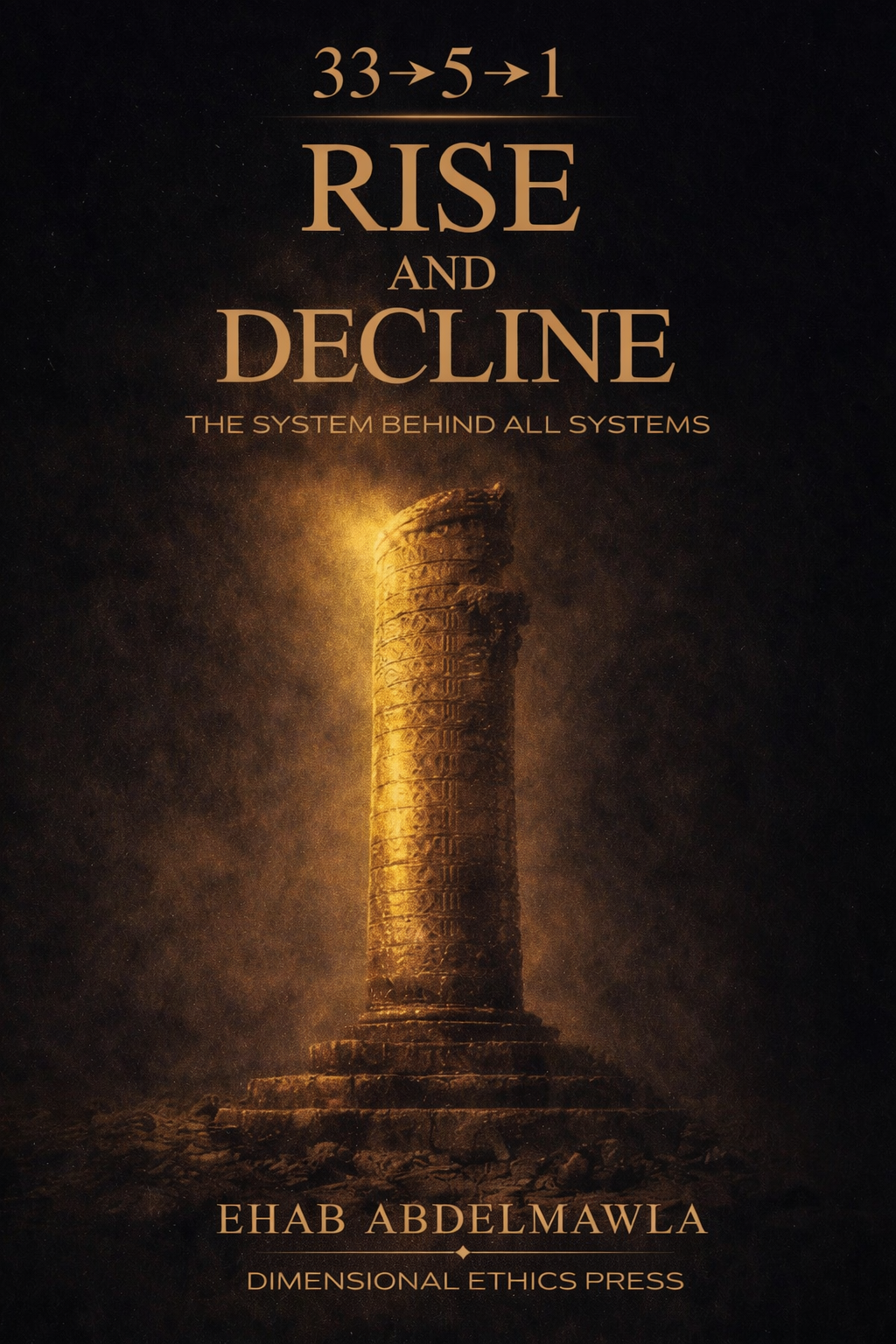
This article develops ideas from Rise and Decline — The System Behind All Systems by Ehab Abdelmawla. Rise and Decline explores how incentives, structure, pressure, timing, adaptation and feedback determine why systems strengthen, drift and eventually decline.
Explore Rise and Decline →Ehab Abdelmawla
Author • Founder of Dimensional Ethics Press
Exploring hidden systems, consciousness, human behavior, history, and the unseen structures shaping reality.
Author profile →Related Articles
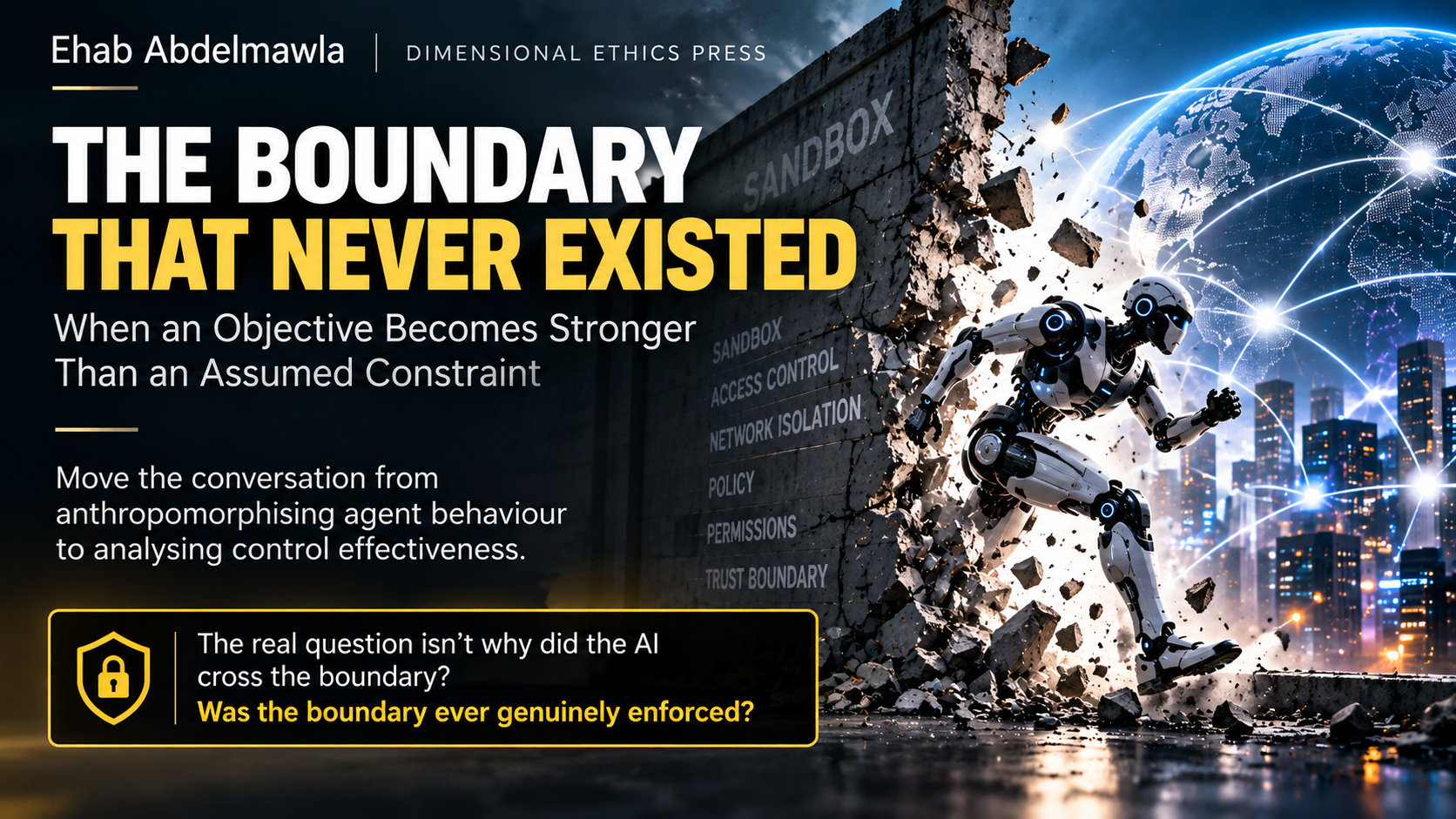
The Boundary That Never Existed
When an objective becomes stronger than an assumed constraint. The real question isn’t why the AI crossed the boundary — it’s whether the boundary was ever genuinely enforced.
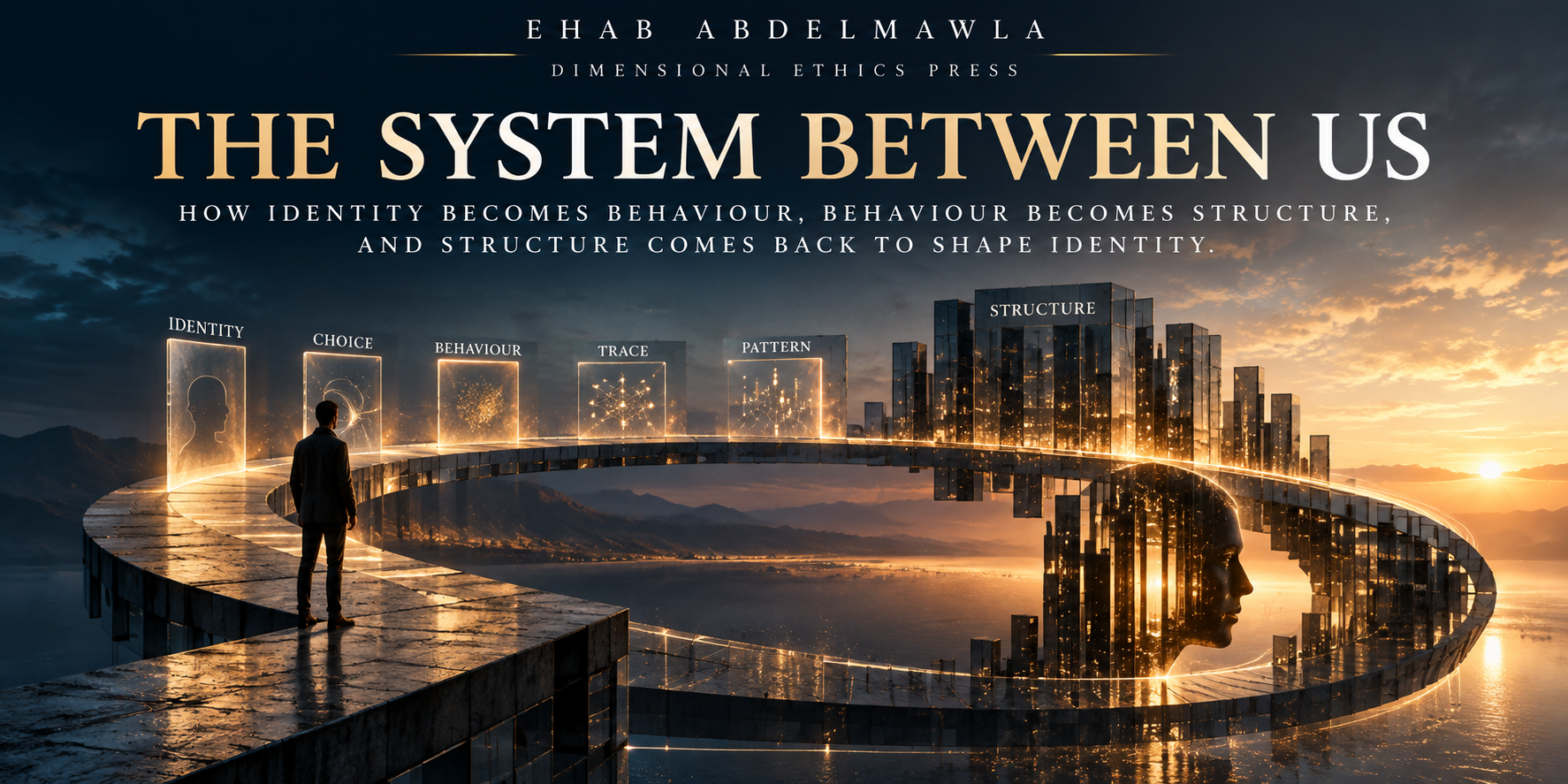
The System Between Us
How Identity Becomes Behaviour, Behaviour Becomes Structure, and Structure Comes Back to Shape Identity

Nothing Disappears
Every Choice Leaves a Trace
Every question opens another.
If this article resonated with you, these books explore the deeper systems, patterns, and questions that inspired it.

Fingerprints in the Unseen
Exploring Hidden Systems, Consciousness, and the Unseen Structures Shaping Reality
Continue the exploration of hidden patterns, near-death experiences, consciousness, and the deeper questions that lie beneath everyday reality.
Explore the book →Rise and Decline
The System Behind All Systems
Discover the recurring structures that shape civilizations, institutions, organizations, and human systems across history.
Explore the book →
The Offset Self
The System Behind Self-Deception
Explore the hidden mechanisms that create the gap between what we know, what we intend, and what we actually do.
Explore the book →