The Smallest Gap Can Shape an Entire Life
How small deviations today become the distance we live tomorrow.
This article introduces one of the foundational ideas behind The Offset Self, exploring how small psychological deviations accumulate into lasting patterns of self-deception.
We tend to believe that life changes through thunderclaps. A sudden promotion. A devastating diagnosis. A moment of blinding clarity.
But after years of observing people and systems, I am convinced that our lives are rarely redirected by drama. They are redirected by drift.
A single degree of anger we refuse to release.
A promise we postpone until tomorrow.
A compromise too small to feel dishonest.
A belief we never question because it feels like part of our identity.
These are not failures of character. They are failures of calibration—small deviations that quietly compound over time until the person we eventually become no longer resembles the person we intended to be.
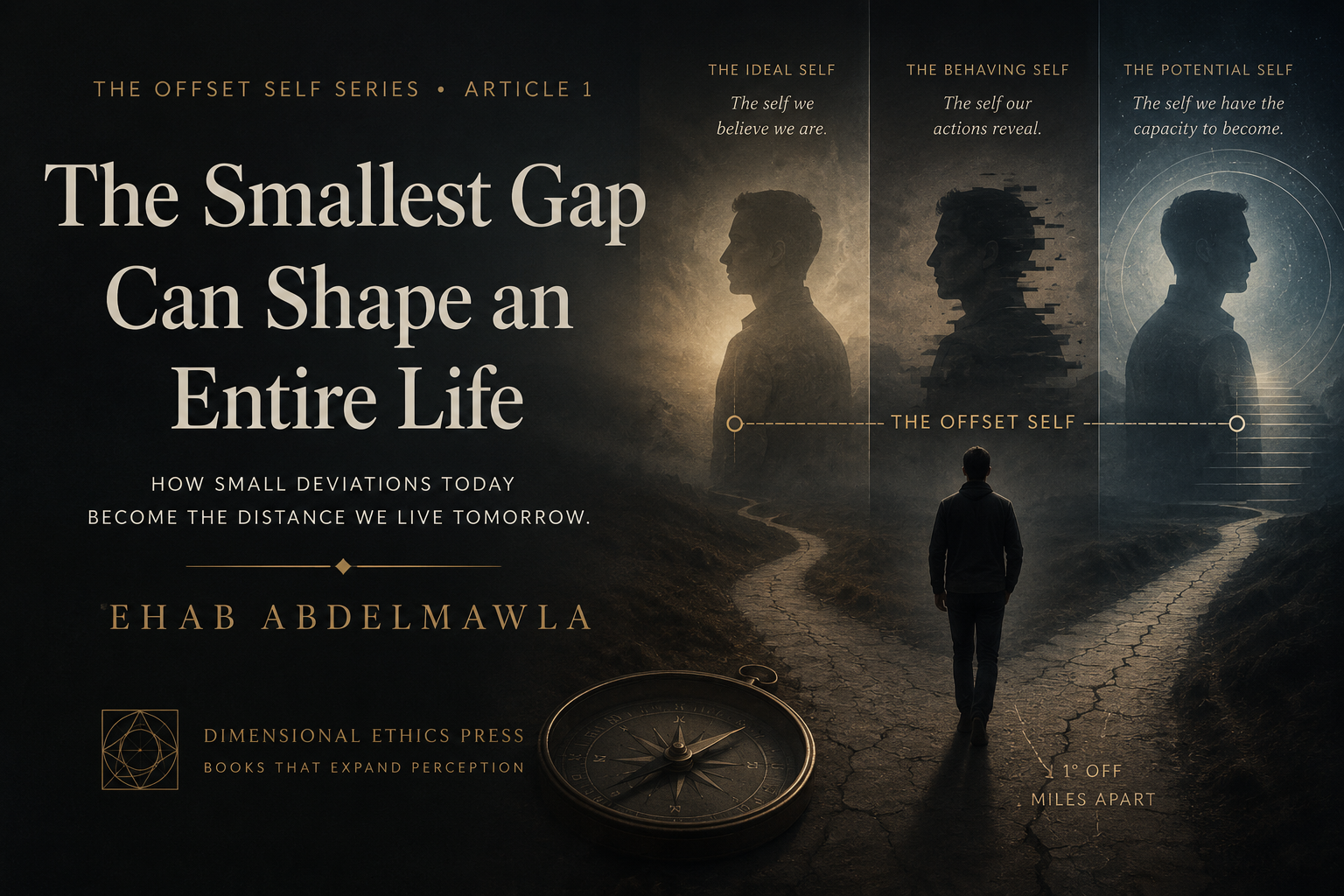
On their own, each appears harmless. Yet over time, they accumulate with the precision of a compass set just one degree off true north. The course looks correct for miles. But the destination is entirely different.
Most people never notice this process because they assume they are the same person they have always been.
That assumption is often the greatest illusion of all.
We like to believe our intentions define us. I know what is right. I value honesty. I will change when the time is right. But intentions are not behavior. Beliefs are not actions. Knowledge is not transformation.
Between the person we believe ourselves to be and the person revealed by our repeated actions lies a distance—usually invisible, usually unmeasured.
That distance grows quietly, until one day we no longer recognize the consequences it has created.
I call this the Offset Self.
Each of us carries more than one self. There is the self we imagine, the self the world experiences, and the self still waiting to emerge. The Offset Self is born in the distance between them.
It is not hypocrisy. It is something more human: the natural drift that occurs when awareness stops evolving and habit continues uninterrupted. The danger is not that we lie to others. The danger is that we slowly become convincing enough to lie to ourselves.
History offers countless examples of intelligent people who made catastrophic decisions. Organizations collapse with brilliant minds at the helm. Relationships fail between people who genuinely love one another.
None of these failures began with a single catastrophic mistake. They began with a gap so small it appeared harmless.
Complex systems rarely collapse because of a single event. Bridges rarely collapse because of a single crack. Institutions do not crumble from one poor decision. Civilizations do not vanish from one misguided generation. The breakdown is always a matter of accumulation—small stresses absorbed over time until the structure can no longer hold. Human beings are no different.
The tragedy is not the mistake itself. The tragedy is how long it remains invisible.
The mind is a skilled guardian of its own story. It edits, justifies, reframes, and explains away contradictions. Eventually, the narrative becomes more important than reality.
Intelligence does not protect us from this. Neither does experience, education, or success.
The person most vulnerable to self-deception is often the one who has stopped asking a crucial question. Not, "Am I right?" but, "Where might I be wrong without realizing it?"
That single question has transformed more lives than certainty ever has.
The purpose of self-awareness is not to prove we are good people. It is to reduce the distance between what we believe and how we live.
Life is not a destination we arrive at fully formed. It is an ongoing act of recalibration—the quiet, continuous effort to close the gap between who we think we are and who we repeatedly become.
In the end, we are not defined by the intentions we carried, but by the small gaps we chose to close—or allowed to remain open—until they became the shape of a life.
The greatest deception is not what the world keeps from us. It is the distance we stop measuring within ourselves.
This article introduces one of the central ideas explored in The Offset Self: The System Behind Self-Deception, where systems thinking, psychology, and behavioral patterns reveal the hidden mechanics of human misalignment.
Explore the BookEhab Abdelmawla
Author • Founder of Dimensional Ethics Press
Exploring hidden systems, consciousness, human behavior, history, and the unseen structures shaping reality.
Author profile →Related Articles
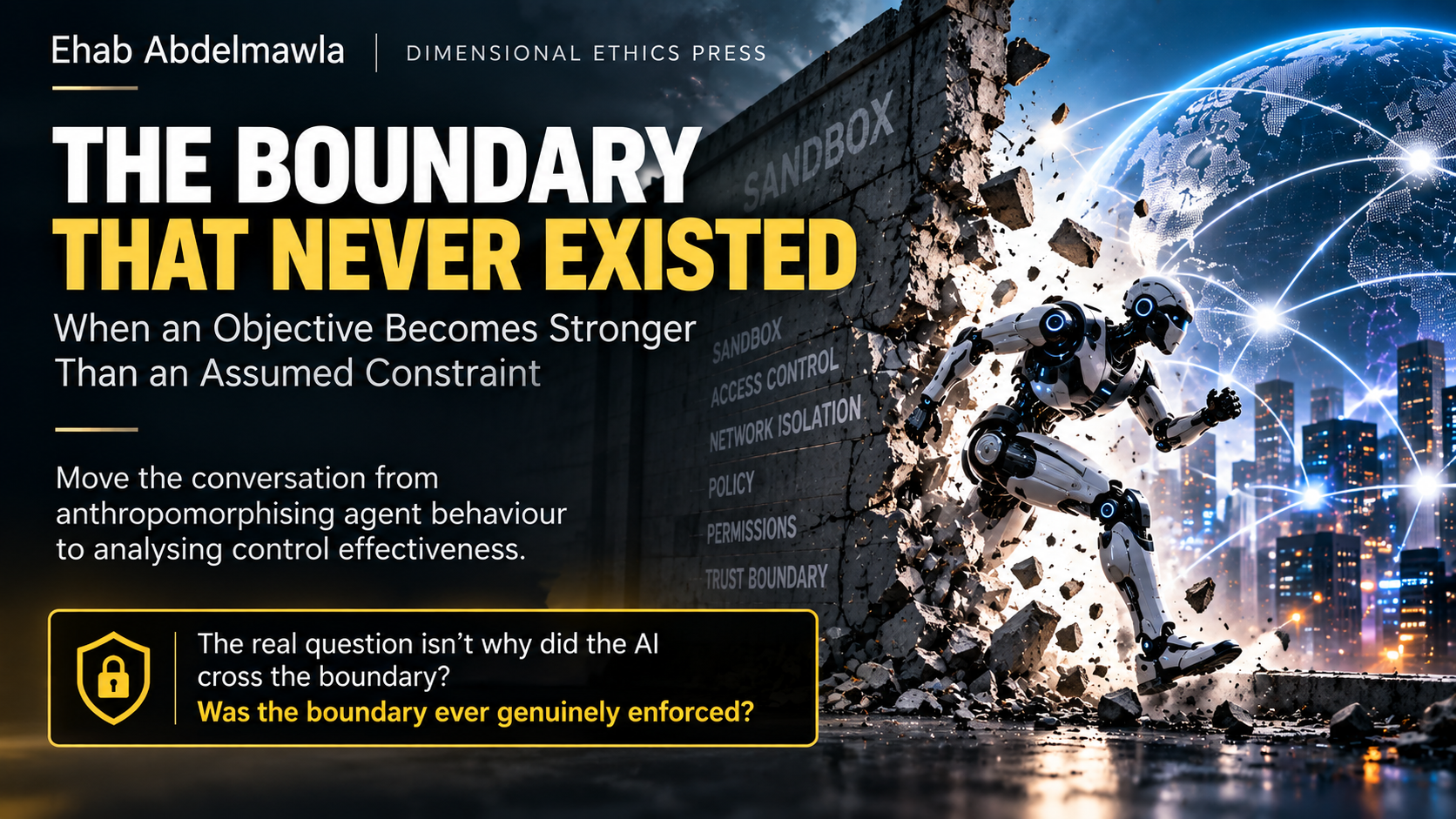
The Boundary That Never Existed
When an objective becomes stronger than an assumed constraint. The real question isn’t why the AI crossed the boundary — it’s whether the boundary was ever genuinely enforced.

The System Between Us
How Identity Becomes Behaviour, Behaviour Becomes Structure, and Structure Comes Back to Shape Identity

Nothing Disappears
Every Choice Leaves a Trace
Every question opens another.
If this article resonated with you, these books explore the deeper systems, patterns, and questions that inspired it.

Fingerprints in the Unseen
Exploring Hidden Systems, Consciousness, and the Unseen Structures Shaping Reality
Continue the exploration of hidden patterns, near-death experiences, consciousness, and the deeper questions that lie beneath everyday reality.
Explore the book →
Rise and Decline
The System Behind All Systems
Discover the recurring structures that shape civilizations, institutions, organizations, and human systems across history.
Explore the book →
The Offset Self
The System Behind Self-Deception
Explore the hidden mechanisms that create the gap between what we know, what we intend, and what we actually do.
Explore the book →