The People A System Selects For
How Unprofessional Environments Reproduce Themselves
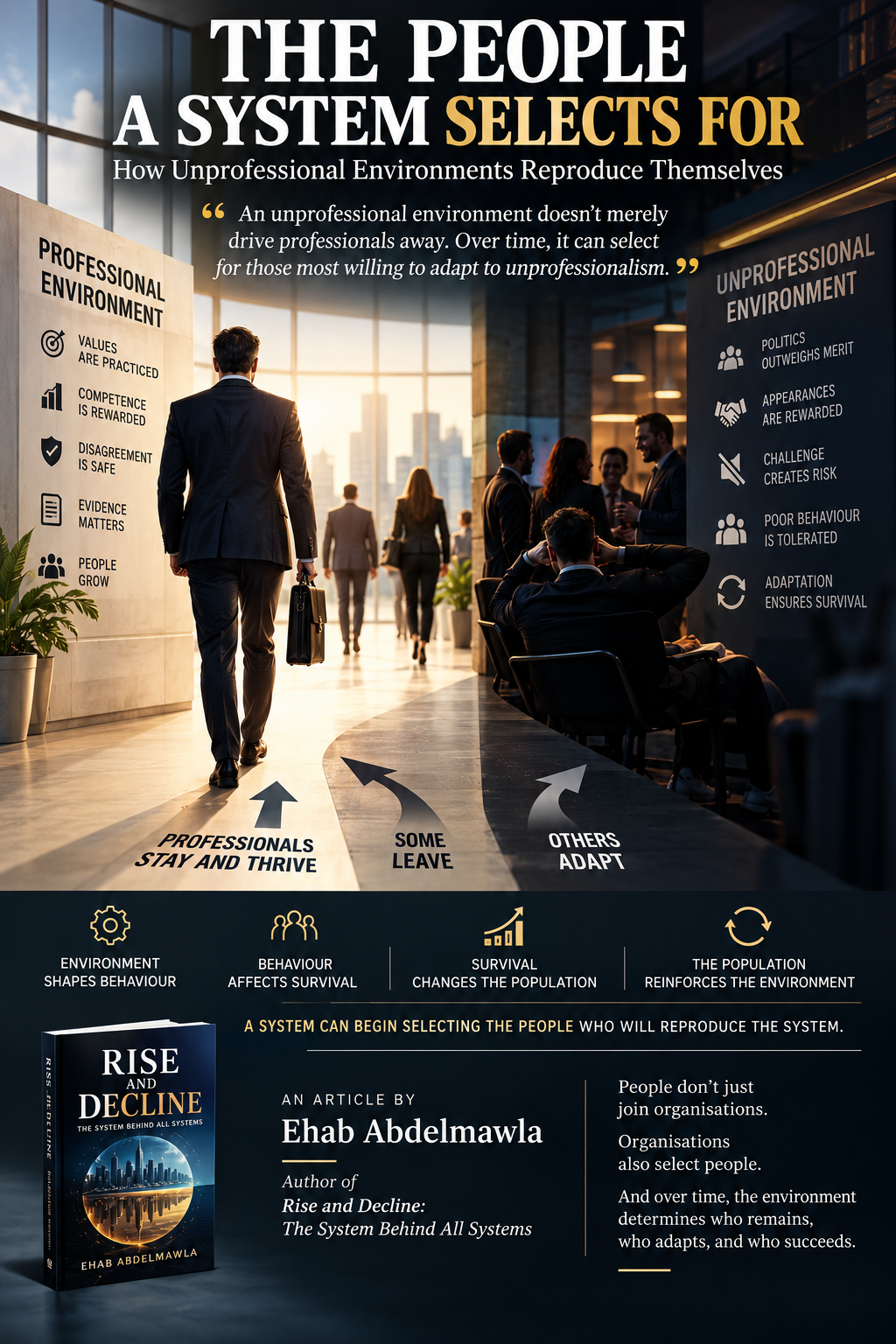
An unprofessional environment does not merely drive professionals away.
Over time, it can select for those most willing to adapt to unprofessionalism.
That distinction matters.
Because when capable people leave a dysfunctional environment, we usually describe the problem as turnover.
Someone resigned.
Another person transferred.
A strong performer found another opportunity.
The organisation recruits replacements.
The positions are filled.
The structure appears intact.
But something deeper may be happening beneath the movement of people.
The system may be changing the type of behaviour most likely to survive inside it.
And once that begins, turnover is no longer simply a human-resources problem.
It becomes a mechanism of system evolution.
PEOPLE DO NOT JUST JOIN ORGANISATIONS
Organisations also select people.
Not only during recruitment.
They continue selecting them every day.
Through what they reward.
What they tolerate.
What they promote.
What they ignore.
What they make difficult.
What they make easy.
What receives recognition.
What creates friction.
What behaviour leads to opportunity.
And what behaviour eventually makes someone wonder whether staying is worth the cost.
Two equally capable professionals can enter the same organisation and respond very differently to its environment.
One adapts.
The other resists.
One learns how decisions are really made.
The other continues expecting decisions to follow the declared process.
One learns when silence is useful.
The other continues asking uncomfortable questions.
One discovers that relationships matter more than evidence.
The other keeps producing evidence.
One becomes increasingly compatible with the environment.
The other becomes increasingly uncomfortable inside it.
Eventually, the organisation may not need to choose between them.
They begin choosing for themselves.
THE HIDDEN SELECTION MECHANISM
Imagine an organisation where professionalism is genuinely rewarded.
Good work receives recognition.
Evidence matters.
Disagreement is possible.
Accountability applies across hierarchy.
People can challenge decisions without becoming the problem themselves.
Information moves relatively freely.
Competence creates opportunity.
The environment sends a signal:
This behaviour works here.
Professionals who value those conditions have reasons to remain.
Now change the environment.
Suppose politics increasingly matters more than competence.
Suppose information is selectively shared.
Suppose poor behaviour is tolerated when it comes from influential people.
Suppose challenge creates unnecessary personal cost.
Suppose visibility matters more than contribution.
Suppose loyalty to individuals becomes more useful than loyalty to principles.
Suppose appearances are rewarded while uncomfortable reality is avoided.
The system is again sending a signal:
This behaviour works here.
The difference is that a different kind of adaptation now becomes advantageous.
ADAPTATION COMES BEFORE SELECTION
Most people do not immediately leave an unhealthy environment.
They adapt first.
They observe.
They test boundaries.
They learn what is safe.
They discover which behaviours produce friction and which produce reward.
This adaptation may begin innocently.
Speak less in this meeting.
Do not challenge that person publicly.
Copy this stakeholder before making a decision.
Avoid raising that issue again.
Make the presentation look positive.
Do not ask why the numbers changed.
Let someone else take the risk.
Nothing dramatic has happened.
No policy has changed.
No announcement has been made.
But behaviour has.
The system is teaching.
And people are learning.
THE COST OF PROFESSIONALISM
Eventually, the crucial variable becomes cost.
Professional behaviour is easy when the environment supports it.
Integrity is easy when honesty is rewarded.
Transparency is easy when inconvenient information is welcomed.
Independence is easy when disagreement carries no personal consequence.
Professionalism becomes meaningful when these behaviours begin to cost something.
Now imagine two employees.
Both understand what good professional practice requires.
The first continues operating according to it even when the environment creates friction.
The second begins adjusting behaviour to reduce that friction.
Neither necessarily becomes a good or bad person.
They are responding differently to incentives.
But their trajectories diverge.
The first person’s cost of remaining increases.
The second person’s cost decreases as they become better adapted to the environment.
Over time, something predictable can happen.
The system begins retaining adaptation and losing resistance.
THIS DOES NOT MEAN EVERY PROFESSIONAL LEAVES
This distinction is important.
People remain in difficult organisations for many reasons.
Financial obligations.
Family circumstances.
Visa conditions.
Career strategy.
Limited alternatives.
Commitment to colleagues.
Belief in the organisation’s mission.
Hope that conditions will improve.
Or simply because they believe the system is worth trying to change.
So remaining inside an unprofessional environment does not make someone unprofessional.
Nor does leaving prove superior professionalism.
The claim is more structural.
When particular professional behaviours repeatedly carry higher costs than their alternatives, the population willing to tolerate those costs can gradually shrink.
That is the selection effect.
SURVIVAL CHANGES THE POPULATION
Suppose an organisation begins with one hundred people with different personalities, standards and tolerances.
The system does not need to deliberately remove its strongest professionals.
It only needs to make certain behaviours increasingly expensive.
Some leave.
Some disengage.
Some transfer.
Some stop challenging.
Some adapt.
Some learn to perform professionalism while operating differently underneath.
New employees arrive.
They observe the survivors.
They learn from those who understand how the organisation really works.
The formal induction tells them one thing.
The environment teaches them another.
And environmental instruction usually wins.
Years later, leadership may look around and conclude:
This is simply our culture.
But culture did not mysteriously appear.
It was selected.
WHO GETS PROMOTED MATTERS EVEN MORE
Retention is only half the mechanism.
Promotion accelerates it.
Every promotion communicates information.
Not merely about the person promoted, but about the behaviour associated with advancement.
People watch.
Who receives visibility?
Who gains authority?
Who gets protected after mistakes?
Who receives opportunities?
Who can challenge senior people?
Who must remain silent?
Who is described as leadership material?
Who is considered difficult?
Every answer teaches the organisation something.
A promotion is therefore more than a personnel decision.
It can be a behavioural signal.
When the system repeatedly advances people whose behaviour reflects its dysfunctional characteristics, those characteristics acquire authority.
Now they can influence recruitment.
Performance assessment.
Work allocation.
Promotion.
Decision-making.
And the selection mechanism becomes stronger.
The system begins selecting the people who will later select others.
That is when culture becomes architecture.
PROFESSIONALISM CAN BECOME A DISADVANTAGE
This sounds paradoxical.
How could professionalism become a disadvantage inside an organisation that publicly values professionalism?
Because declared values and operating incentives are not always the same thing.
Consider someone who insists on accurate reporting when optimistic reporting is rewarded.
Their professionalism creates friction.
Someone who raises risk when delivery pressure encourages silence creates friction.
Someone who refuses political behaviour in an environment where relationships determine opportunity may lose influence.
Someone who documents uncomfortable facts may appear less cooperative than someone who quietly accommodates them.
The professional behaviour has not changed.
Its relative fitness inside the environment has.
This is the crucial systems insight.
A behaviour does not survive simply because it is good.
It survives when the surrounding system makes it viable.
THE WRONG LESSON FROM TURNOVER
Organisations can easily misread what happens next.
A strong employee leaves.
Management concludes:
They found a better opportunity.
Perhaps they did.
Another leaves.
Different career direction.
Another disengages.
Performance issue.
Another stops challenging.
They have matured.
Another highly adaptable employee stays and succeeds.
Excellent cultural fit.
Every explanation may contain some truth individually.
But systems thinking asks a different question:
What does the pattern reveal collectively?
If the people experiencing the greatest friction repeatedly share certain professional behaviours, while those flourishing share another set of adaptive behaviours, individual explanations may be hiding a structural selection process.
The question is no longer:
Why did this person leave?
It becomes:
What kind of person does this environment make it easiest to remain?
That is a far more uncomfortable question.
CULTURE DOES NOT ONLY SHAPE BEHAVIOUR
We often say organisational culture influences how people behave.
True.
But incomplete.
Culture also influences who remains available to influence the culture.
That creates a loop.
Environment shapes behaviour.
Behaviour affects survival.
Survival changes the population.
The surviving population reinforces the environment.
And the environment shapes the next generation of behaviour.
The system is now reproducing itself.
This explains why dysfunctional cultures can persist even after some of the original people responsible for them have left.
The behaviour has moved beyond individuals.
It has entered selection.
THE PROFESSIONAL WHO ADAPTS
There is another uncomfortable possibility.
The system does not necessarily lose the professional.
Sometimes it changes them.
A person enters with strong standards.
Initially they challenge what seems wrong.
Then they discover challenge produces little change.
They become more selective.
Then quieter.
Then pragmatic.
They learn which battles are worth fighting.
Then which battles cannot be won.
Eventually they stop seeing certain behaviours as unusual.
What once disturbed them becomes normal.
They may even teach newcomers how to navigate it.
“Don’t worry about that.”
“That’s just how things work here.”
“Don’t raise that in the meeting.”
“Speak to this person first.”
“Just give them what they want.”
The transformation may be so gradual that nobody notices it.
Including the person.
The system did not remove the professional.
It converted resistance into adaptation.
NORMALISATION IS MORE POWERFUL THAN ENFORCEMENT
A dysfunctional system does not need everyone to agree with it.
It only needs enough people to behave as though its operating rules are normal.
That is much easier.
People can privately disagree while publicly adapting.
They can recognise dysfunction while participating in it.
They can dislike political behaviour while learning to use political behaviour defensively.
They can value transparency while selectively withholding information because everyone else does.
Eventually the distinction between adaptation and endorsement becomes difficult to see.
The behaviour has become normalised.
And once normalised, it becomes teachable.
THEN THE SYSTEM STARTS HIRING ITSELF
The loop can go even further.
People who survive and advance eventually participate in recruitment.
What do they recognise as a “good fit”?
Often, consciously or unconsciously, characteristics compatible with the environment they themselves learned to navigate.
Candidates who challenge assumptions may seem difficult.
Candidates who question unclear structures may seem insufficiently pragmatic.
Candidates skilled at reading hierarchy may appear politically sophisticated.
Candidates who mirror existing behaviour may feel culturally compatible.
Now the system is no longer merely changing people after they arrive.
It is selecting compatible people before they enter.
Culture has entered recruitment.
The organisation is beginning to reproduce itself intentionally without necessarily understanding what it is reproducing.
RISE AND DECLINE
This mechanism sits directly inside the framework of Rise and Decline: The System Behind All Systems.
Systems do not rise or decline simply because they contain good or bad people.
They evolve through the interaction of:
Direction. Incentives. Structure. Adaptation. Feedback.
An organisation may declare the correct direction.
Its strategy may be excellent.
Its values may be admirable.
Its policies may be professionally written.
But if its incentives reward behaviour inconsistent with those declarations, people adapt.
If the structure protects that adaptation, it becomes easier.
If feedback fails to expose the divergence, it persists.
And if the people most compatible with that environment are increasingly retained and promoted, the system begins reproducing the very conditions responsible for its decline.
What began as behaviour becomes structure.
What became structure begins selecting behaviour.
DECLINE CAN BECOME SELF-REINFORCING
This is why decline can accelerate.
At first, the system contains people who remember another standard.
They notice the difference.
They challenge it.
They compare current behaviour with what the organisation claims to value.
Some leave.
Some adapt.
Some become silent.
As their influence decreases, resistance decreases with it.
The remaining environment becomes more internally consistent.
Ironically, it may even feel more harmonious.
There are fewer disagreements.
Fewer challenges.
Fewer uncomfortable conversations.
More people understand “how things work.”
But internal harmony does not necessarily mean organisational health.
Sometimes disagreement disappears because the system has gradually removed, converted or silenced the behaviours capable of producing it.
A system can become more culturally stable while becoming less professionally healthy.
THE REVERSE IS ALSO TRUE
Fortunately, selection works in both directions.
A professional environment can also reproduce itself.
Reward evidence and people learn that evidence matters.
Protect constructive disagreement and thoughtful challengers remain engaged.
Hold authority accountable and professional managers gain legitimacy.
Promote people who combine delivery with integrity and others learn that the combination is viable.
Correct mistakes without destroying people and honest reporting becomes safer.
Reward collaboration rather than political positioning and collaboration becomes adaptive.
Good systems also select.
They retain people who thrive under good conditions.
They attract others like them.
They promote behaviours that reproduce those conditions.
Professionalism becomes not merely an expectation.
It becomes the easiest way to succeed.
That is when culture begins working with the organisation rather than against it.
THE QUESTION LEADERS SHOULD ASK
Organisations spend enormous effort asking:
How do we attract talented people?
A more revealing question may be:
What kind of behaviour does our environment make most likely to stay, adapt and succeed?
Because recruitment determines who enters.
But the system determines what happens afterward.
Who thrives?
Who becomes exhausted?
Who adapts?
Who goes silent?
Who leaves?
Who gets promoted?
Who eventually gains enough authority to choose the next generation?
Taken individually, these appear to be separate personnel decisions.
Taken together, they describe the evolution of the system.
THE PEOPLE A SYSTEM SELECTS FOR
An unprofessional environment does not automatically become filled with unprofessional people.
Human beings are more complicated than that.
Professionals can remain.
They can resist.
They can improve systems.
And dysfunctional behaviour can be corrected.
But over time, incentives accumulate.
Adaptation accumulates.
Departures accumulate.
Promotions accumulate.
Silence accumulates.
And eventually the population of the organisation can begin reflecting the environment that selected it.
At that point, the system no longer needs anyone to deliberately preserve the culture.
The culture has acquired its own reproduction mechanism.
The environment shapes who survives.
Those who survive shape the environment.
And eventually:
the system begins selecting the people who will reproduce the system.
That is how an unprofessional environment can become something more dangerous than a bad place to work.
It can become a self-reinforcing system of decline.
— Ehab Abdelmawla Rise and Decline: The System Behind All Systems Dimensional Ethics Press
Explore how direction, incentives, structure, adaptation and feedback shape the people and behaviours that survive inside a system.
Explore Rise and Decline →Ehab Abdelmawla
Author • Founder of Dimensional Ethics Press
Exploring hidden systems, consciousness, human behavior, history, and the unseen structures shaping reality.
Author profile →Related Articles
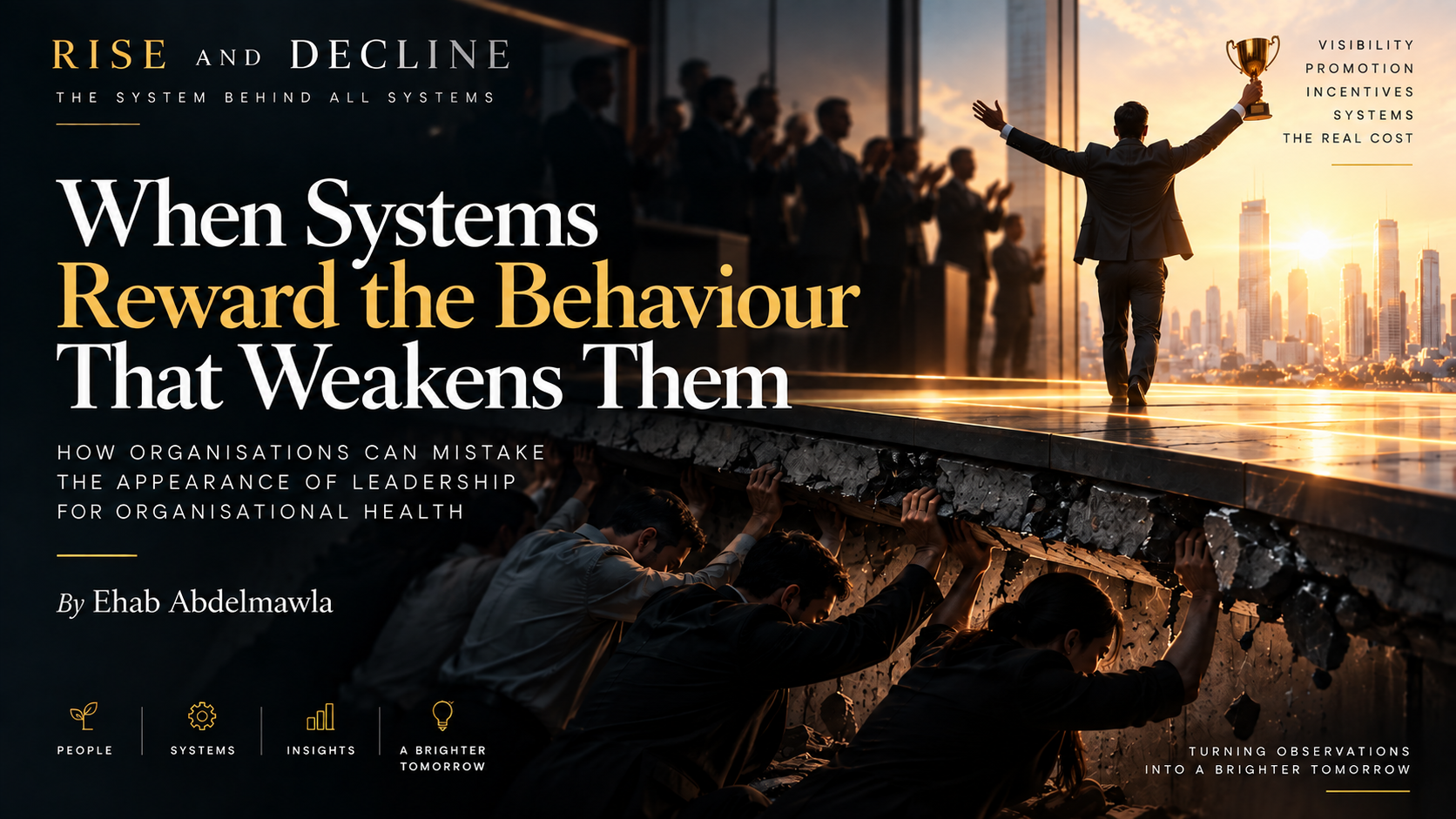
When Systems Reward the Behaviour That Weakens Them
How organisations can mistake the appearance of leadership for organisational health
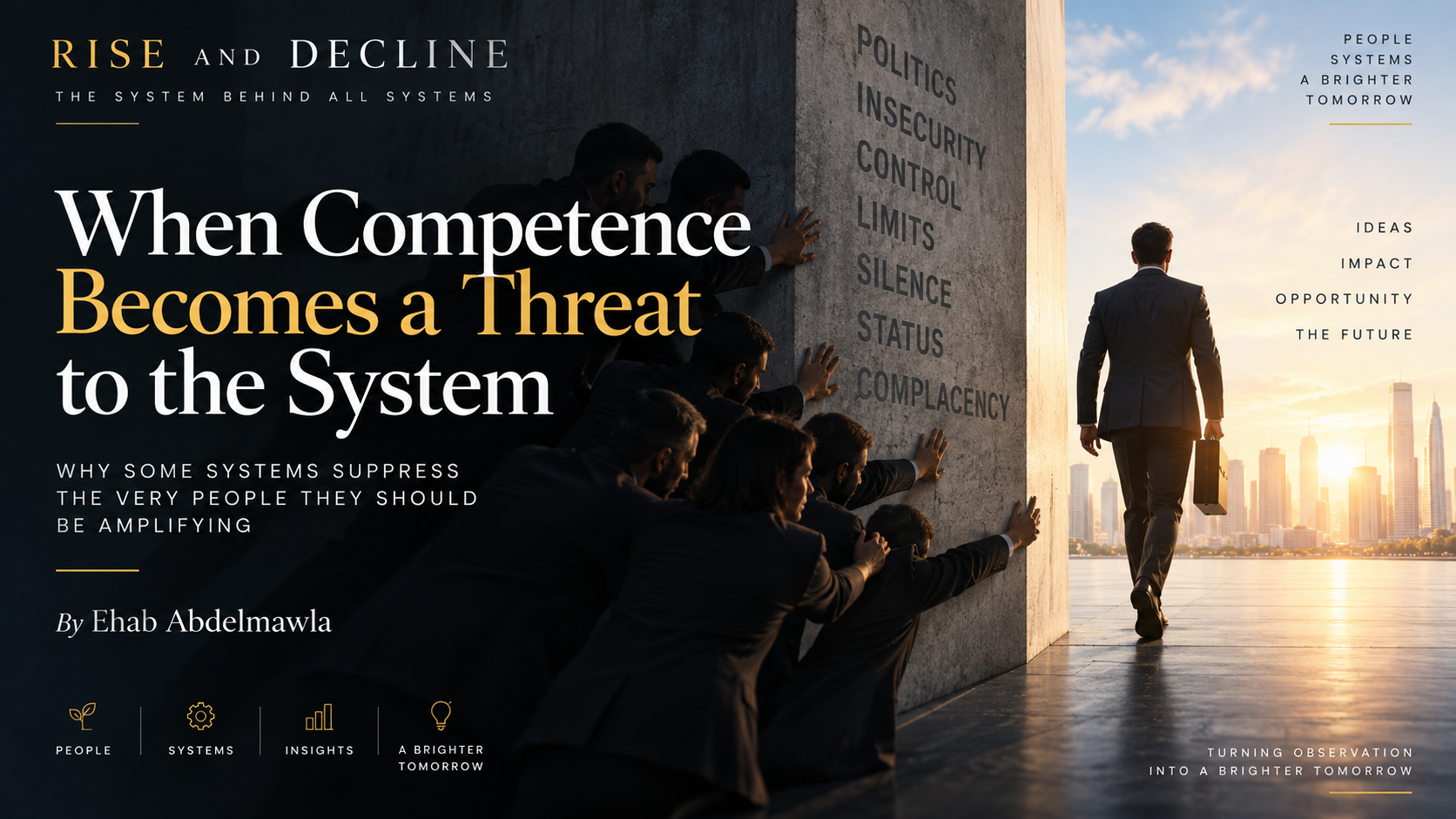
When Competence Becomes a Threat to the System
Why some systems suppress the very people they should be amplifying
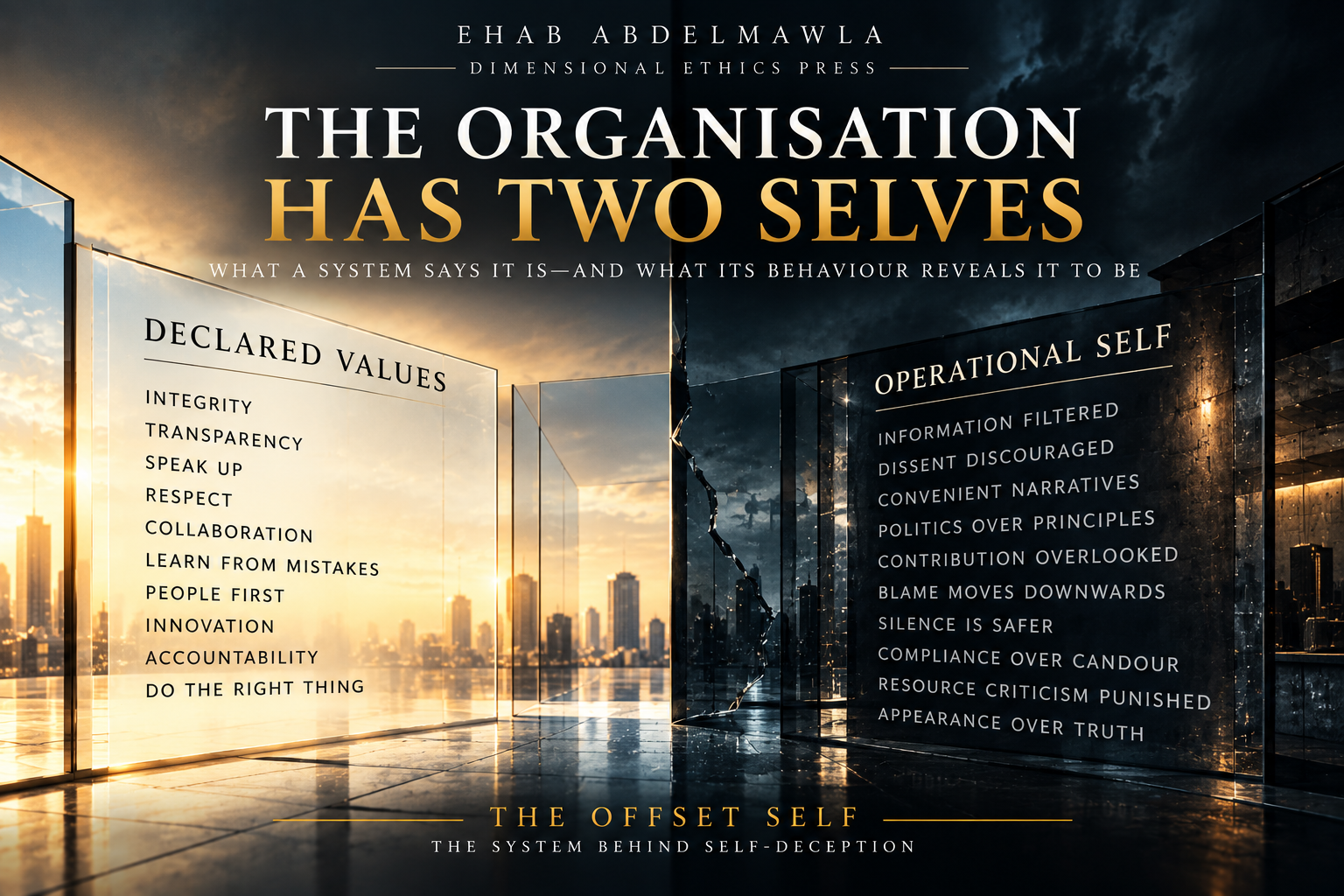
The Organisation Has Two Selves
What a System Says It Is—and What Its Behaviour Reveals It to Be
Every question opens another.
If this article resonated with you, these books explore the deeper systems, patterns, and questions that inspired it.
Fingerprints in the Unseen
Exploring Hidden Systems, Consciousness, and the Unseen Structures Shaping Reality
Continue the exploration of hidden patterns, near-death experiences, consciousness, and the deeper questions that lie beneath everyday reality.
Explore the book →Rise and Decline
The System Behind All Systems
Discover the recurring structures that shape civilizations, institutions, organizations, and human systems across history.
Explore the book →
The Offset Self
The System Behind Self-Deception
Explore the hidden mechanisms that create the gap between what we know, what we intend, and what we actually do.
Explore the book →