What If the Wound Was Waiting for Something Else?
A near-death account raises a provocative question: can a consequence remain active because the conditions required for its resolution have never been satisfied?
We tend to believe that suffering belongs to the person experiencing it.
An injury belongs to the body.
Fear belongs to the mind.
Guilt belongs to memory.
And the consequences of our actions belong to the past.
We separate them because they appear to exist in different places.
But what if those separations are not as absolute as we believe?
What if the visible consequence is only one part of a relationship we cannot see?
And what if something that appears resolved in one dimension remains unfinished in another?
A remarkable near-death experience raises precisely these questions.
Not because it proves the existence of an unseen system.
But because it describes a possibility that challenges the boundaries of our ordinary understanding of cause and effect.
The Wound That Waited
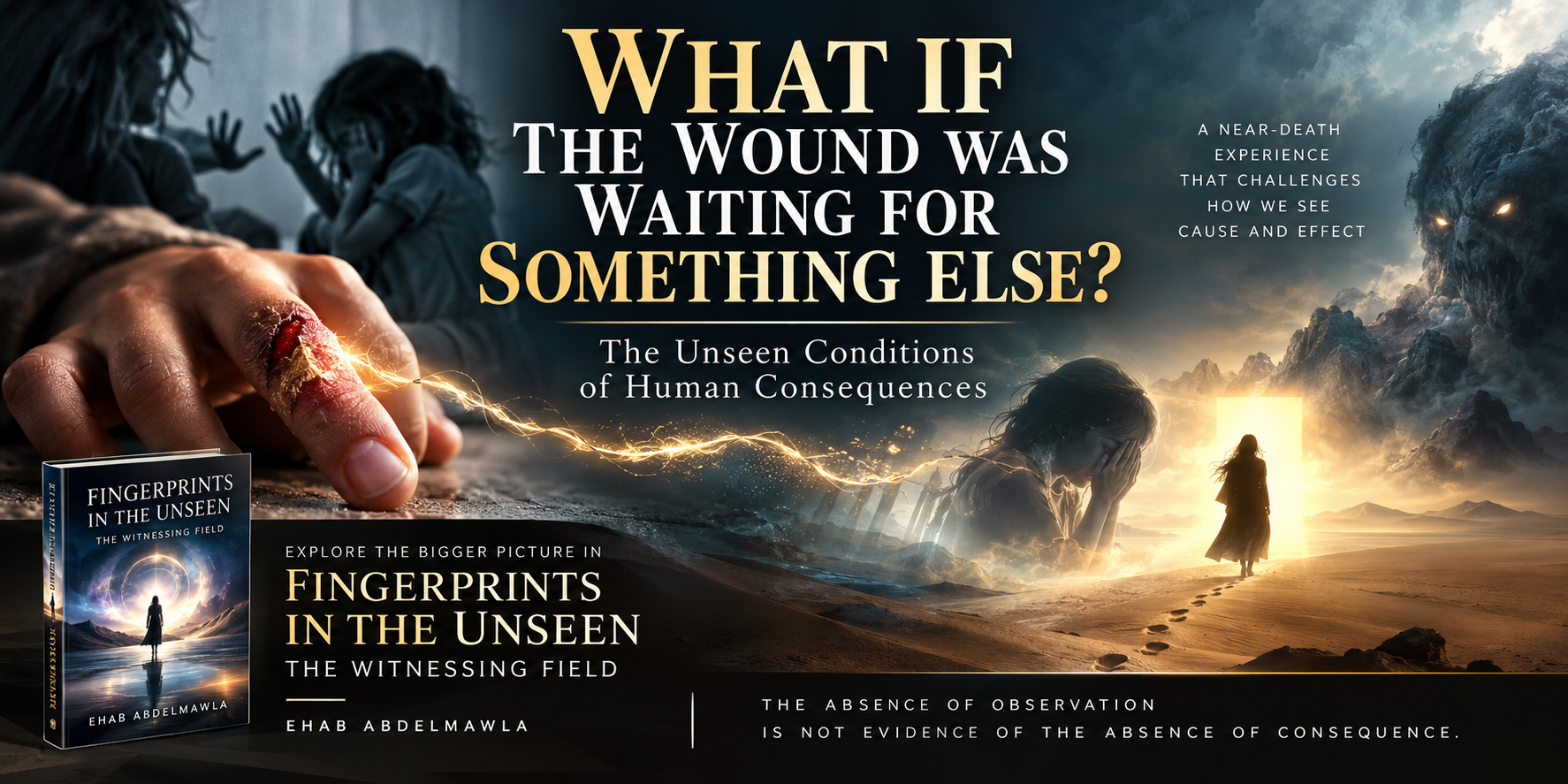
A child deliberately frightens and injures two other children.
One suffers an injured wrist.
The other suffers a wound to her back.
Both experience intense fear.
The incident ends.
Two weeks later, the child responsible suffers an injury to her finger.
The wound refuses to heal.
Her family seeks treatment. Dressings are applied. Remedies are attempted.
Days become weeks.
Weeks become months.
An entire year passes.
Then her uncle threatens her with something terrifying.
She believes the threat.
For the first time, she experiences fear of an intensity she had never previously known.
Within a week, the wound reportedly heals.
Decades later, during a near-death experience, she describes being shown a connection between these events.
She is told that the wound could not heal because the fear she had caused remained uncompensated.
The physical suffering was not enough.
Something else was outstanding.
Only when she experienced equivalent fear could the wound resolve.
Consider the implications of that claim.
The wound was not merely the consequence.
Its continued existence was conditional on an outstanding emotional consequence.
The distinction changes everything about the proposed relationship.
It suggests that the problem was not simply located in the injured finger.
The finger was where the consequence appeared.
But the condition governing its resolution allegedly existed elsewhere.
In another experience.
In another moment.
In another person’s suffering.
We cannot establish from this testimony that emotional equivalence caused the wound to heal. Ordinary medical explanations remain possible, including the reported disturbance of its dressing.
But the philosophical proposition deserves examination.
Because it asks us to consider a relationship between events that our conventional categories would ordinarily keep separate.
What If the Visible Problem Is Not the Whole Problem?
Imagine a system in which a visible condition remains active because an invisible dependency has not been satisfied.
The visible component may be functioning exactly as the system requires.
Yet its state cannot change.
Not because the component itself is defective.
But because the conditions for transition have not been met.
We understand this principle in engineered systems.
A process remains suspended until a dependency is resolved.
A transaction cannot complete while an outstanding condition remains.
An apparently independent component may depend on a state somewhere else in the architecture.
But we rarely apply this way of thinking to human consequences.
We assume the injury and the emotion are separate.
We assume the person who caused harm and the person who experienced it occupy independent moral and physical realities.
We assume that when an action ends, whatever remains belongs to those who carry it.
What if those assumptions are incomplete?
The near-death account describes a hypothetical system in which consequences are not isolated events.
They are relationships.
And relationships can remain active even when the original event has disappeared.
The child no longer remembers the fear she caused.
The frightened children have returned home.
The original confrontation has ended.
Yet, within the account’s interpretation, something remains unresolved.
The event has ended. The relationship between its consequences has not.
That is the distinction.
The Past May Be Finished Without Being Resolved
We often confuse the passage of time with resolution.
An argument happened twenty years ago.
A betrayal occurred in childhood.
A humiliating remark was spoken during a meeting.
A decision destroyed someone’s opportunity.
Years pass.
People move on.
The original event becomes history.
But does becoming history mean its consequences have ceased?
A person may still organise their behaviour around a humiliation they experienced decades earlier.
A family may continue living with the effects of a decision made by someone long dead.
An organisation may continue reproducing a harmful pattern long after the individual who introduced it has departed.
The original cause is no longer present.
Its consequences remain operational.
This is not mysterious.
It is how systems work.
The disappearance of a cause does not guarantee the disappearance of its effects.
But the near-death account goes further.
It proposes that some consequences may remain not merely because their effects persist, but because an outstanding condition prevents their resolution.
That is a much stronger claim.
And it raises a difficult question.
Could something remain unresolved even when the person experiencing it has no knowledge of what remains outstanding?
The Witness Who Knew More Than the Person Living
During the same experience, the individual describes reliving her life from two perspectives.
One self performs the original actions.
Another watches.
The acting self possesses only the knowledge available at the time.
The witnessing self appears to understand what those actions produced.
The witness recognises mistakes.
She attempts to warn the person she once was.
But the acting self cannot hear her.
The events continue unchanged.
This distinction reaches directly into the questions explored in Fingerprints in the Unseen — The Witnessing Field.
Is the consciousness that experiences an event necessarily identical to the perspective that later understands it?
We normally experience ourselves as a continuous identity.
I acted.
I remembered.
I understood.
But these are not necessarily the same functions.
The person who acts does not possess complete knowledge of the consequences.
The person who remembers reconstructs the event through a different understanding.
The person who witnesses may recognise relationships the original actor never perceived.
In ordinary life, we call this reflection.
The near-death account describes something considerably more expansive.
The witness reportedly experiences not only her own actions, but the suffering of those affected.
She becomes aware of injuries, fear, and disturbances that were outside her original perception.
Whether this represents access to information beyond ordinary consciousness or an extraordinary reconstruction of experience remains unknown.
But the distinction is philosophically important.
Perhaps the most consequential limitation of human identity is not that we cannot see the future.
It is that we cannot fully see the present we are creating for others.
We act within the boundaries of our perspective.
The consequences do not necessarily remain within those boundaries.
What If Intention Is Only Part of the Equation?
Later in the experience, the individual describes encountering a terrifying creature in a desolate landscape.
She is told that the creature originated from hurtful words she had spoken to someone close to her.
The words had caused suffering that continued for months.
The relationship had remained damaged for sixteen years.
She protests that she did not know her words would hurt the other person so deeply.
People are different, she explains.
One person might hear those words and dismiss them.
Another might carry them for years.
And here the account introduces one of its most uncomfortable propositions.
What if the consequences of our actions are not measured solely by what we intended, but also by what others actually experienced?
We know what we said.
We know what we meant.
We know whether we intended to cause harm.
But we do not necessarily know what our words became inside another person.
A sentence that means little to its speaker may become a defining memory for its recipient.
A joke may become humiliation.
A criticism may become insecurity.
An act of exclusion may become a lasting sense of worthlessness.
The person responsible may have forgotten the event before the other person has even begun processing it.
This does not mean that every painful reaction establishes wrongdoing, or that responsibility is unlimited.
Intention, context, proportionality, and foreseeability still matter.
But it challenges the assumption that the person performing an action possesses complete authority to determine its significance.
The author of an action is not necessarily the author of its consequences.
And the account adds another uncomfortable detail.
When confronted with the harm she caused, the individual argues that the other person had also spoken hurtfully.
The response is simple.
The other person’s actions are their own responsibility.
One wrongdoing does not erase another.
A familiar human defence suddenly becomes irrelevant.
But they hurt me too.
Perhaps they did.
That does not make the consequences of our own actions disappear.
When Good Deeds Return
The experience contains another remarkable episode.
While trapped in the frightening landscape, the individual pleads for help.
Then a figure intervenes.
She is told that two acts of kindness from her past have created an opportunity for her to escape.
Years earlier, she had helped two women establish families through marriage.
Those actions had apparently remained consequential long after she performed them.
And now, within the experience, they worked in her favour.
This changes the proposed architecture.
The system is not simply one of punishment.
It is also one of protection.
Harm may create outstanding consequences.
Kindness may create future opportunities.
And those consequences may interact in ways the original actor never anticipated.
But notice something important.
The good deeds did not necessarily erase the harm.
They created an opportunity for intervention.
This suggests a distinction between two possible functions.
Equivalence may address an outstanding consequence.
Mercy may alter how that consequence is experienced.
One concerns resolution.
The other concerns the conditions under which resolution becomes possible.
We do not know whether such mechanisms exist beyond the experience.
But their distinction raises a question worth considering.
What if the value of a good action is not exhausted when its immediate benefit has been delivered?
A person helps someone today.
The recipient’s life changes.
That person influences others.
The consequences spread beyond the original relationship.
The giver may never witness what followed.
Yet the effects continue.
We can observe this in ordinary human life without invoking any supernatural mechanism.
Kindness, like harm, can propagate through relationships.
The near-death account proposes something additional: that beneficial actions may remain relevant to the future experiences of the person who performed them.
It is a metaphysical possibility, not an established law.
But it reveals a compelling symmetry.
If harm can outlive the moment that produced it, why should goodness be confined to the moment in which it was performed?
The Unseen Is Not Necessarily the Supernatural
When we speak about the unseen, we often imagine another world.
Something beyond the physical.
Something inaccessible to ordinary perception.
But much of what shapes human life is already unseen.
We cannot directly observe another person’s complete emotional experience.
We cannot see every consequence of a decision.
We cannot know every relationship our actions create.
We cannot fully trace the effects of our behaviour through the lives of others.
Yet those effects are real.
They influence decisions, relationships, institutions, and future behaviour.
The unseen is not always something outside reality.
Sometimes it is simply the part of reality that lies beyond our present capacity to observe.
This is one of the central questions behind Fingerprints in the Unseen.
Does the boundary of observation define the boundary of existence?
Of course not.
But recognising that some things exist beyond our awareness does not prove that every proposed unseen mechanism is real.
That distinction matters.
The near-death experience does not establish that unresolved emotional harm prevents physical wounds from healing.
Nor does it establish that illness is evidence of wrongdoing.
People suffer from diseases and injuries for many well-understood reasons. Innocent people experience terrible misfortune. No one should interpret another person’s illness as proof of hidden moral debt.
The account instead provides a provocative model for examining something more fundamental.
The relationship between action, consequence, awareness, and resolution.
And perhaps the most important distinction of all:
A system may continue operating whether or not the person inside it understands its conditions.
The Question We Rarely Ask
We spend enormous effort trying to understand why things happen.
Why did the relationship collapse?
Why did the conflict continue?
Why did the institution fail?
Why did the same behaviour return?
Why did the consequences persist?
We search for causes.
But perhaps we sometimes overlook a different question.
What condition has not yet been satisfied?
This is not a claim that every problem has a hidden moral explanation.
It is a way of thinking about persistence.
A conflict may continue because accountability has never occurred.
A relationship may remain damaged because acknowledgment was never offered.
An institution may repeatedly fail because the incentives sustaining the failure remain unchanged.
A person may continue reproducing a destructive pattern because the underlying conditions have never been addressed.
In these examples, the visible problem is not necessarily the complete problem.
The unresolved condition may exist elsewhere in the system.
And until that condition changes, the visible consequence may continue.
This is where the philosophical proposition becomes useful even without accepting the supernatural interpretation of the near-death account.
Resolution is not always achieved by treating what is visible. Sometimes it requires identifying what continues to sustain it.
The Fingerprint That Remains
Return to the child.
The two frightened girls.
The wound that reportedly remained open for a year.
The terrifying threat.
The sudden healing.
We can interpret these events through ordinary medicine, psychology, coincidence, memory, or the metaphysical explanation offered during the near-death experience.
We do not possess enough evidence to establish the extraordinary explanation as fact.
But the experience confronts us with a question that deserves more attention than the simple language of reward and punishment.
Can a consequence remain active because something necessary for its resolution remains outstanding?
In observable human systems, the answer is often yes.
In the proposed relationship between emotional harm and physical healing, the answer remains unknown.
And that distinction is where serious inquiry begins.
The Witnessing Field does not need to begin with certainty.
It begins with the recognition that what we experience may not reveal every relationship operating around us.
An action can end while its consequences continue.
A person can forget while another remembers.
A system can preserve effects long after the event that produced them has disappeared.
And understanding may arrive long after the opportunity to change the original action has passed.
Perhaps that is the most unsettling part of this entire experience.
Not the possibility that our actions are recorded somewhere beyond our awareness.
Not the possibility that consequences may return to us.
But the possibility that we may spend our lives believing certain events are finished simply because we can no longer see what they are doing.
The action ends.
The moment disappears.
The world moves forward.
But what if the consequence is still waiting?
The Witnessing Field
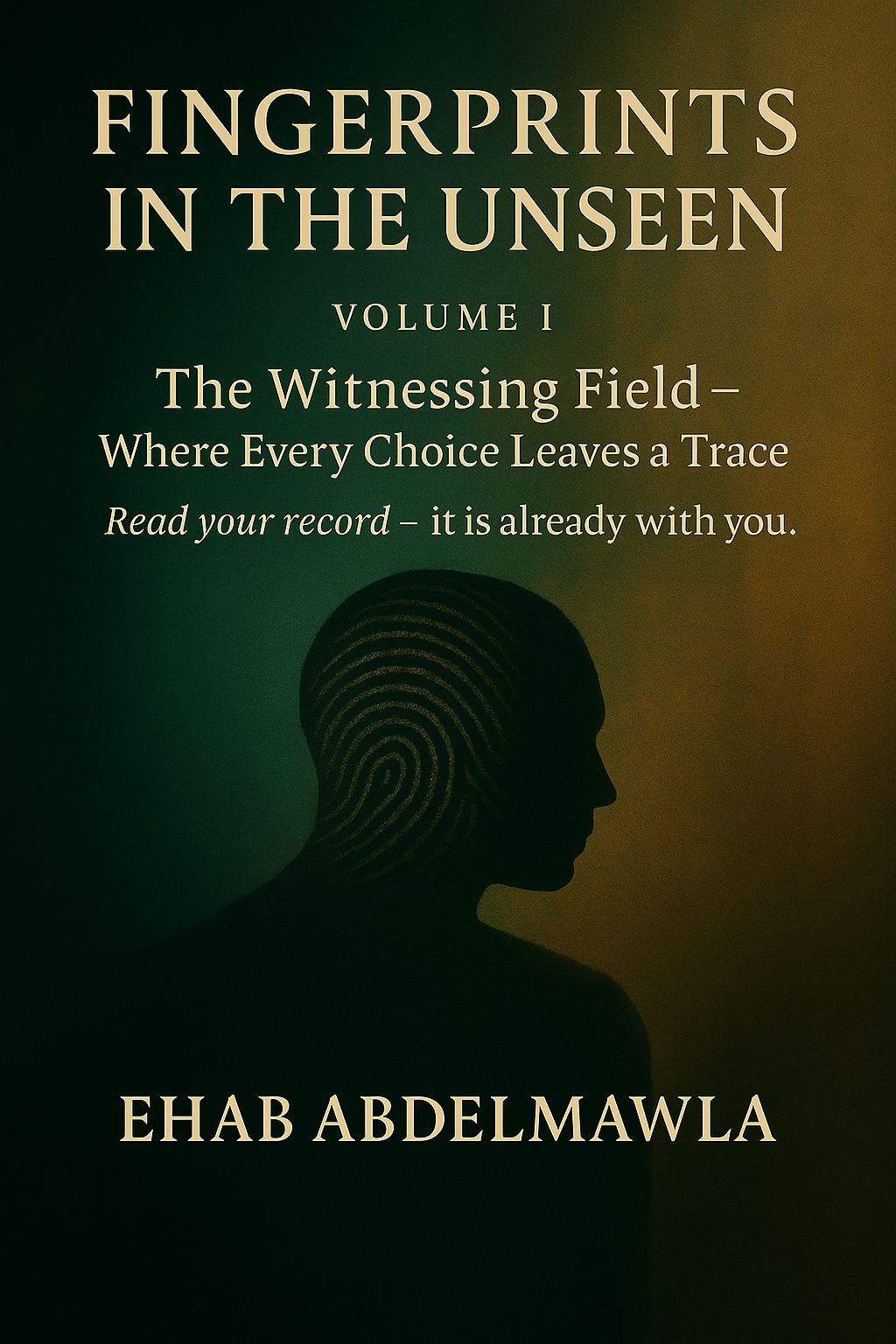
This article explores one of the central questions behind Fingerprints in the Unseen: that what we experience may not reveal every relationship operating around us. An action can end while its consequences continue. A person can forget while another remembers. And the absence of observation is not evidence of the absence of consequence.
Continue with:
Fingerprints in the Unseen
The Witnessing Field and the Architecture of Consequences
By Ehab Abdelmawla
Ehab Abdelmawla
Author • Founder of Dimensional Ethics Press
Exploring hidden systems, consciousness, human behavior, history, and the unseen structures shaping reality.
Author profile →Related Articles
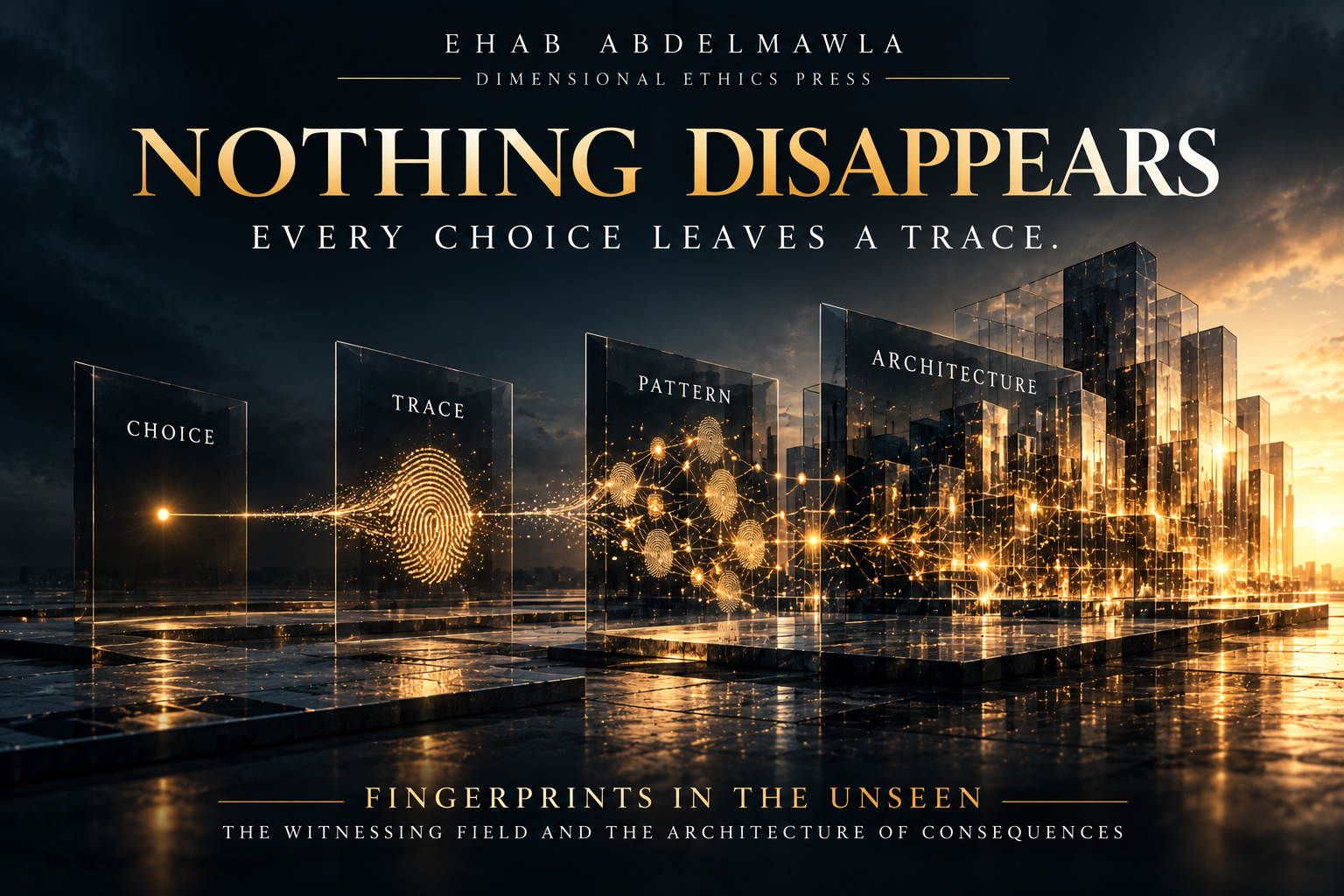
Nothing Disappears
Every Choice Leaves a Trace
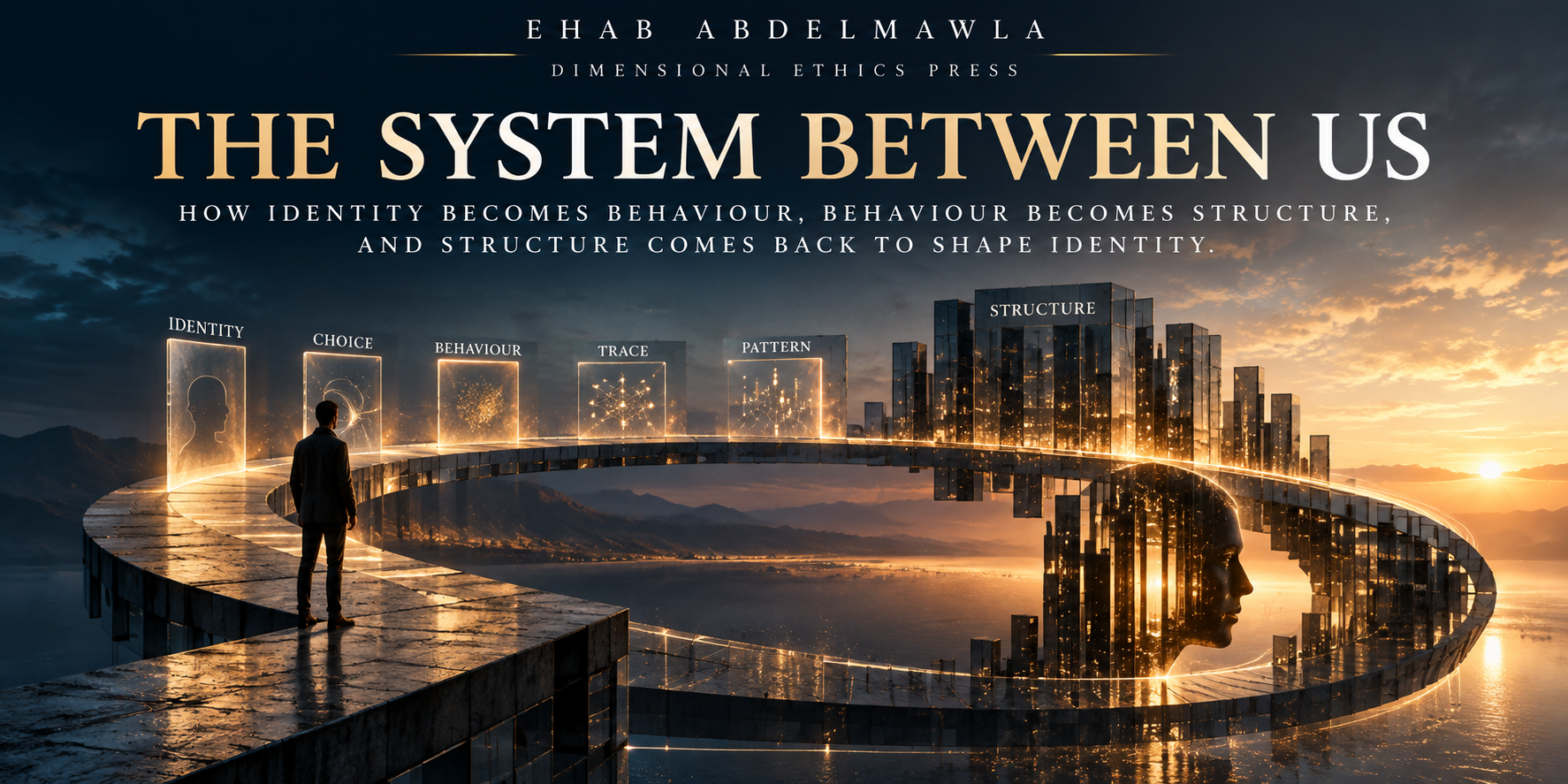
The System Between Us
How Identity Becomes Behaviour, Behaviour Becomes Structure, and Structure Comes Back to Shape Identity
The Network of Claims
What if the greatest burden we carry is not what we have done—but what we have left unresolved?
Every question opens another.
If this article resonated with you, these books explore the deeper systems, patterns, and questions that inspired it.
Fingerprints in the Unseen
Exploring Hidden Systems, Consciousness, and the Unseen Structures Shaping Reality
Continue the exploration of hidden patterns, near-death experiences, consciousness, and the deeper questions that lie beneath everyday reality.
Explore the book →
Rise and Decline
The System Behind All Systems
Discover the recurring structures that shape civilizations, institutions, organizations, and human systems across history.
Explore the book →
The Offset Self
The System Behind Self-Deception
Explore the hidden mechanisms that create the gap between what we know, what we intend, and what we actually do.
Explore the book →