No One Above the System
Why accountability must increase with authority, not disappear behind it.

An organisation can have policies, governance frameworks, codes of conduct, risk committees, internal audits, employee surveys, whistleblowing channels and formal investigation processes.
And still have a fundamental weakness.
The rules may not operate equally at every level of authority.
An employee makes a mistake.
It is documented.
A manager behaves inappropriately.
It becomes a performance conversation.
A senior executive makes a questionable decision.
It becomes a matter of judgment, context or strategic necessity.
Perhaps each response is justified.
Different responsibilities require different considerations.
But what happens when the difference is not based on evidence, seriousness or responsibility?
What happens when it is based on hierarchy?
That is where accountability stops functioning as a system control and begins functioning as a privilege distributed by authority.
And once that happens, the consequences extend far beyond any individual decision.
AUTHORITY IS NECESSARY
Every functioning organisation requires authority.
Someone must establish direction.
Someone must allocate resources.
Someone must resolve competing priorities.
Someone must make decisions under uncertainty.
Someone must accept responsibility for outcomes.
Without authority, organisations can become paralysed.
But authority creates an important structural asymmetry.
The more authority someone possesses, the more people and processes their decisions can affect.
A frontline employee may influence a task.
A manager may influence a team.
An executive may influence an entire division.
A chief executive may influence the direction, incentives and operating conditions of the organisation itself.
The consequences of decisions expand with authority.
So why would accountability move in the opposite direction?
THE ACCOUNTABILITY PARADOX
In theory, greater authority carries greater responsibility.
In practice, authority can also provide greater protection.
Senior leaders often possess advantages that others do not.
They influence organisational narratives.
They control access to information.
They participate in decisions about resources and priorities.
They have established relationships with other decision-makers.
Their judgments may receive greater initial credibility.
Their decisions may be interpreted within a broader strategic context.
None of these advantages necessarily represents wrongdoing.
Many are legitimate features of leadership.
The problem emerges when these advantages influence whether conduct is examined, how evidence is interpreted, or what consequences follow.
An organisation can gradually develop two standards.
One for those subject to authority.
Another for those exercising it.
And the existence of two standards changes the behaviour of the entire system.
ACCOUNTABILITY IS NOT PUNISHMENT
This distinction matters.
Holding someone accountable does not mean assuming they are wrong.
It does not mean demanding disciplinary action whenever someone complains.
It does not mean treating senior leaders with suspicion.
And it certainly does not mean that every unpopular management decision is misconduct.
Leadership involves difficult choices.
Resources are limited.
Employees disagree.
Priorities conflict.
Some decisions will disappoint people even when they are entirely justified.
Accountability means something more precise.
A person exercising authority must be able to explain decisions, demonstrate their basis, accept scrutiny and face proportionate consequences when evidence establishes wrongdoing or failure.
That principle should apply throughout the organisation.
The outcome may differ according to responsibility, impact, intent and circumstances.
But the obligation to answer for decisions should not disappear with seniority.
SENIORITY CHANGES THE SCALE OF CONSEQUENCE
Consider two people who make the same type of mistake.
One is an individual contributor.
The other controls an entire business function.
The behaviour may appear similar.
But the consequences may not be.
A misleading statement from one employee might affect a project.
A misleading statement from an executive might influence investment, workforce decisions, regulatory reporting or organisational strategy.
An inappropriate interaction between colleagues may damage a working relationship.
The same behaviour by someone controlling promotion, performance and employment decisions can influence the behaviour of an entire team.
Authority amplifies consequence.
That does not automatically make every senior-management mistake more serious.
Context still matters.
But it does mean that the scope of influence must form part of the accountability assessment.
The greater the authority, the greater the potential reach of an error.
And a system that ignores this relationship misunderstands its own risk.
WHEN HIERARCHY BECOMES EVIDENCE
One of the most subtle failures occurs when authority begins influencing credibility.
A senior leader provides an explanation.
It is treated as authoritative.
An employee provides a different account.
It requires additional verification.
Sometimes that difference is reasonable.
A leader may possess information unavailable to others.
But access to information is not the same as factual accuracy.
Position is not proof.
Confidence is not evidence.
Experience does not eliminate the possibility of error.
And organisational status does not make someone immune to bias.
A mature system should therefore ask:
What supports this explanation?
Not merely:
Who provided it?
The same standard should apply to everyone.
An employee’s allegation should be tested.
A manager’s response should be tested.
A senior executive’s explanation should be tested.
The evidence may ultimately support any of them.
But hierarchy should not determine the answer before the examination begins.
THE DANGER OF PROTECTING AUTHORITY
Organisations sometimes confuse protecting leadership with protecting the organisation.
The reasoning can appear sensible.
A senior leader is important.
Their reputation matters.
Their removal could disrupt operations.
Their decisions affect strategic commitments.
Public disagreement could weaken confidence.
The organisation therefore becomes cautious about challenging them.
Caution itself is not necessarily wrong.
Confidentiality, fairness and continuity matter.
But a dangerous transformation occurs when these considerations begin overriding evidence.
The organisation stops asking:
What happened?
And begins asking:
What would happen if we acknowledged what happened?
These are fundamentally different questions.
The first seeks truth.
The second manages consequences.
Both may eventually require attention.
But the second must not determine the answer to the first.
THE COST OF SELECTIVE ACCOUNTABILITY
Imagine an organisation where employees are regularly reminded of expected conduct.
Policies are clear.
Training is mandatory.
Compliance is measured.
Incidents are documented.
But when similar concerns involve influential leaders, the response becomes less consistent.
Employees notice.
Not necessarily because they have access to confidential findings.
But because they observe behaviour.
They see what continues.
What changes.
What receives attention.
What gets ignored.
Which standards appear enforceable.
And which appear negotiable.
Over time, employees begin learning the organisation’s actual rules.
Not the written ones.
The operational ones.
Accountability that changes with hierarchy teaches people that authority matters more than principle.
That lesson can become more influential than any code of conduct.
THE SYSTEM LEARNS WHAT IT TOLERATES
Every organisational response communicates information.
When a junior employee is held accountable for misconduct, observers learn that the behaviour carries consequences.
When a manager is fairly investigated and cleared, observers learn that allegations can be tested without automatically destroying reputations.
When a senior executive is held accountable following substantiated findings, observers learn that authority has boundaries.
But when misconduct is established and tolerated because of someone’s position, a different lesson emerges.
The behaviour may be unacceptable, but sufficiently powerful people can survive it.
That lesson changes incentives.
People begin adjusting their behaviour.
Some become cautious about raising concerns.
Others learn that proximity to authority provides protection.
Still others conclude that advancement requires political adaptation rather than professional consistency.
Now accountability has become connected to organisational selection.
The system begins rewarding behaviours that should have been corrected.
ACCOUNTABILITY AND THE SELECTION EFFECT
This connects directly to another principle explored in Rise and Decline:
Systems do not merely influence behaviour. They select for the behaviours most compatible with their operating conditions.
If professional conduct is consistently rewarded, people have reasons to maintain it.
If misuse of authority is tolerated, people may learn that authority offers protection.
If challenging inappropriate conduct carries greater personal risk than engaging in it, the incentive structure becomes inverted.
Over time, the organisation may retain and promote people who adapt to that structure.
Those people eventually gain authority themselves.
They influence recruitment.
Performance assessment.
Promotion.
Governance.
And future accountability decisions.
The system begins reproducing the conditions that created the problem.
Selective accountability is therefore not merely unfair. It can become a mechanism of organisational decline.
THE LEADERSHIP EXCEPTION
Every organisation needs discretion.
Not every mistake requires formal discipline.
Not every disagreement requires investigation.
Not every poor decision constitutes misconduct.
But discretion must be distinguishable from exemption.
A senior leader may receive a different response because the circumstances genuinely differ.
That can be appropriate.
However, if the explanation for different treatment ultimately reduces to seniority, influence, reputation or organisational convenience, accountability has weakened.
The critical distinction is simple:
Different circumstances may justify different outcomes. Different status should not automatically justify different standards.
This is not about making everyone identical.
It is about ensuring that evidence and responsibility remain more important than position.
WHO HOLDS THE PEOPLE IN CHARGE ACCOUNTABLE?
This is perhaps the most difficult governance question.
Managers hold employees accountable.
Senior managers hold managers accountable.
Executives hold senior managers accountable.
Boards oversee executives.
But what happens when the people responsible for accountability are themselves connected to the decisions under examination?
What happens when they approved the approach?
Supported the manager?
Received the original reporting?
Defended the outcome?
Or have an interest in preserving the existing explanation?
The issue is not necessarily dishonesty.
It is independence.
A person can act sincerely and still have a conflict of interest.
A system designed around accountability must therefore recognise when authority and independence become incompatible.
That may require independent review.
Alternative reporting channels.
External assurance.
Board-level oversight.
Or decision-making arrangements that separate those involved in the original matter from those evaluating it.
The exact mechanism depends on the organisation.
But the principle is universal.
No system should rely entirely on the judgment of the same authority whose conduct is being questioned.
ACCOUNTABILITY MUST FOLLOW THE DECISION
There is another common weakness.
Organisations frequently measure outcomes without examining how those outcomes were produced.
A manager delivers targets.
An executive reduces costs.
A division meets deadlines.
A program achieves its milestones.
The results look positive.
But what if the results were achieved through practices that created hidden organisational damage?
What if people stopped reporting risks?
What if professional challenge was discouraged?
What if resources were misrepresented?
What if delivery pressure caused controls to be bypassed?
What if the apparent success depended on costs transferred elsewhere?
The performance outcome may be real.
But incomplete.
A mature accountability system must examine both:
What was achieved?
and
How was it achieved?
Because a result cannot be fully understood without the mechanisms that produced it.
ACCOUNTABILITY IS A FEEDBACK CONTROL
In Rise and Decline: The System Behind All Systems, the trajectory of a system is shaped by the relationship between direction, incentives, structure, adaptation and feedback.
Accountability operates across all five.
It reinforces direction by making declared expectations meaningful.
It shapes incentives by determining which behaviours carry consequences.
It strengthens structure by establishing boundaries around authority.
It influences adaptation by teaching people what works.
And it protects feedback by ensuring that uncomfortable information can reach decision-makers without being automatically neutralised by hierarchy.
Remove accountability from senior management and the entire mechanism becomes distorted.
The people with the greatest ability to shape the system become less exposed to the feedback required to correct their decisions.
That is a structural contradiction.
The people with the greatest influence over a system must not become the people least reachable by its corrective mechanisms.
WHAT A HEALTHY SYSTEM SHOULD DO
A mature organisation does not need to distrust its leaders.
It needs to design accountability so that trust does not depend entirely on personal character.
That means applying consistent evidentiary standards.
Ensuring allegations can be disproved.
Providing procedural fairness.
Separating investigations from conflicts of interest.
Examining the organisational impact of substantiated conduct.
Correcting inaccurate records when necessary.
Reviewing decisions affected by established misconduct.
Applying proportionate consequences.
And identifying whether the system itself contributed to the failure.
Most importantly, it means recognising that accountability does not end when an individual matter is closed.
If a management failure exposed a weakness in governance, that weakness remains even after the individual case has been resolved.
The system must learn.
THE SENIOR LEADER WHO WELCOMES ACCOUNTABILITY
There is a positive dimension to this argument.
Accountability should not be viewed as an attack on leadership.
For capable leaders, it can be a source of legitimacy.
A leader who accepts scrutiny demonstrates confidence in the integrity of their decisions.
A leader who corrects mistakes shows that authority is compatible with learning.
A leader who permits independent examination strengthens confidence in the institution.
A leader who holds peers accountable demonstrates that organisational standards are not merely instruments for managing subordinates.
Such leadership changes the environment.
Employees become more willing to raise concerns.
Managers become more careful about how decisions are made.
Evidence gains importance.
Professional behaviour becomes more viable.
The system becomes better able to correct itself.
Accountability does not weaken legitimate authority. It gives authority a stronger foundation.
NO ONE ABOVE THE SYSTEM
An organisation does not become healthy because its leaders are powerful.
It becomes healthy when power operates within boundaries that remain meaningful.
Those boundaries must apply to everyone.
Employees.
Managers.
Senior managers.
Executives.
And those responsible for governing the organisation itself.
Not because everyone is equally responsible for every outcome.
They are not.
But because everyone must remain answerable for the authority they exercise and the consequences they create.
The higher someone rises, the more influence their decisions can have.
That influence should bring greater responsibility for evidence, conduct, transparency and correction.
Not immunity.
Because when accountability weakens at the top, the consequences do not remain at the top.
They travel downward.
Through management behaviour.
Through incentives.
Through organisational culture.
Through the people who remain.
Through the people who leave.
Through the behaviours the system eventually selects for.
And over time, selective accountability can become part of the architecture of decline.
A system that holds employees accountable but protects authority from accountability is not enforcing standards.
It is enforcing hierarchy.
And the ultimate test of organisational maturity is not whether it can hold its least powerful people accountable.
It is whether it can apply the same commitment to evidence and responsibility when the person being examined has the power to influence the system itself.
No one should be above the system.
Especially those entrusted with leading it.
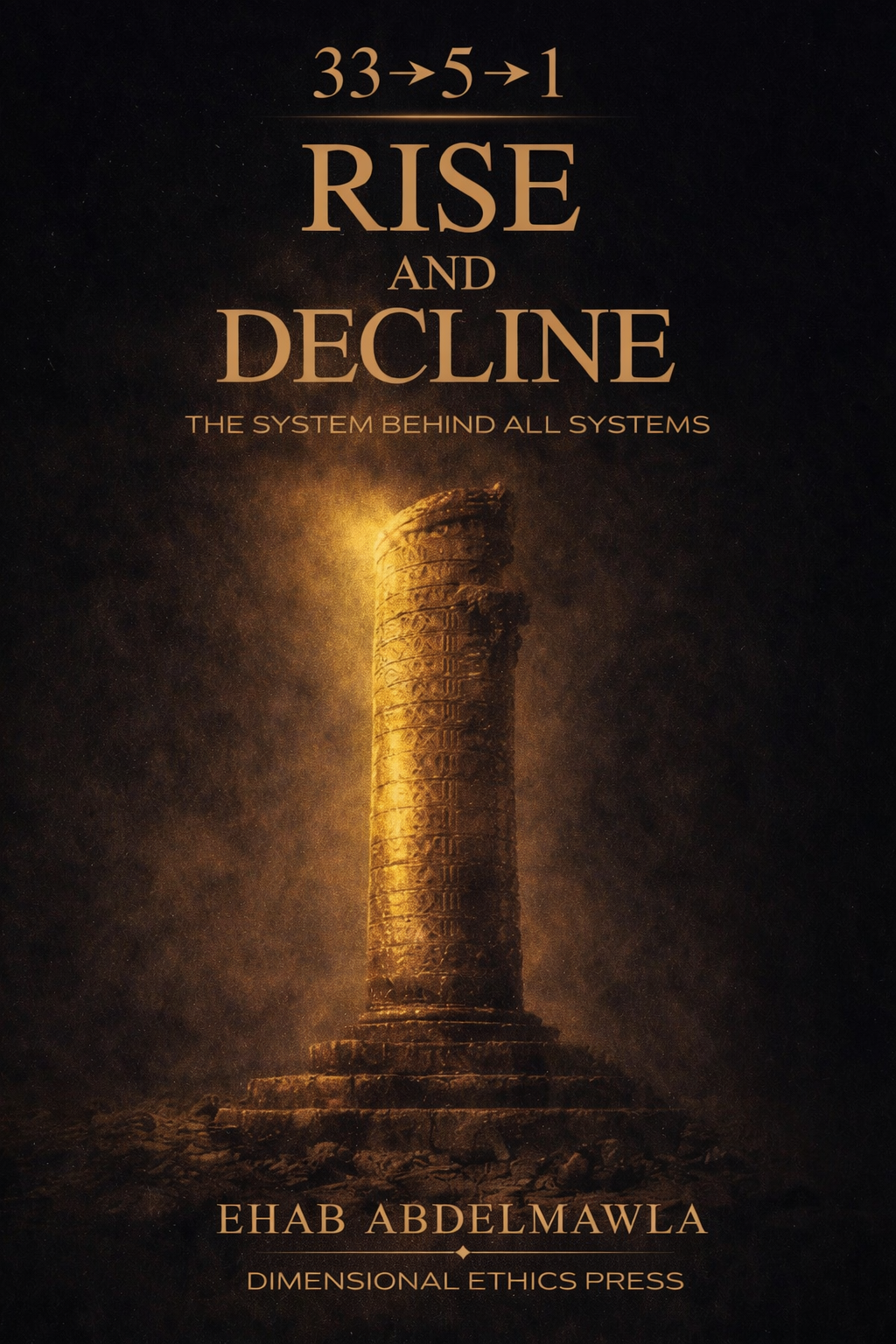
Explore how direction, incentives, structure, adaptation and feedback determine whether a system can correct itself — and why accountability must reach those with the greatest influence over it.
Explore Rise and Decline →Ehab Abdelmawla
Author • Founder of Dimensional Ethics Press
Exploring hidden systems, consciousness, human behavior, history, and the unseen structures shaping reality.
Author profile →Related Articles

The People A System Selects For
How Unprofessional Environments Reproduce Themselves

Performance Theatre
When a System Measures the Truth but Cannot Afford to See It
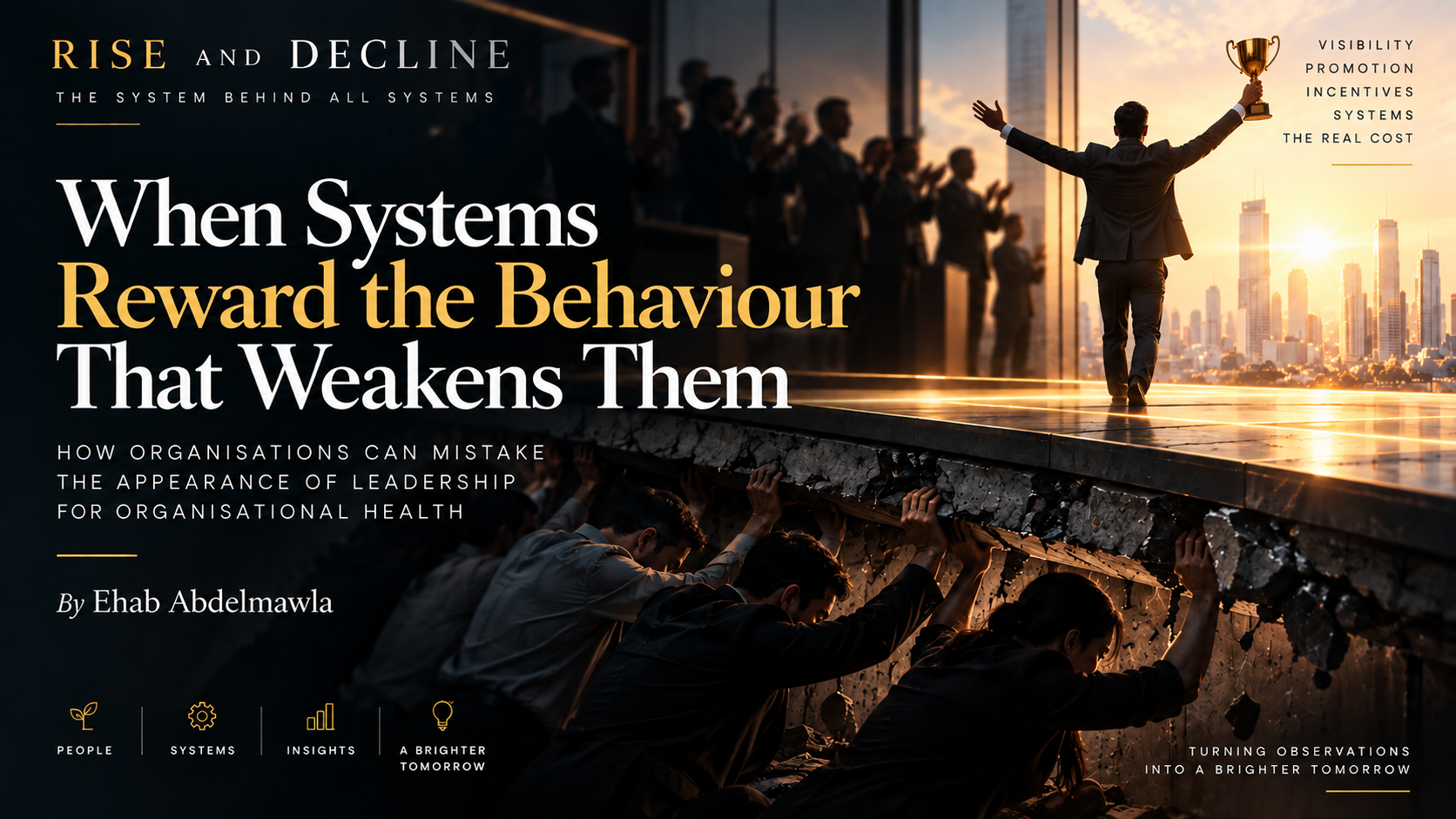
When Systems Reward the Behaviour That Weakens Them
How organisations can mistake the appearance of leadership for organisational health
Every question opens another.
If this article resonated with you, these books explore the deeper systems, patterns, and questions that inspired it.

Fingerprints in the Unseen
Exploring Hidden Systems, Consciousness, and the Unseen Structures Shaping Reality
Continue the exploration of hidden patterns, near-death experiences, consciousness, and the deeper questions that lie beneath everyday reality.
Explore the book →Rise and Decline
The System Behind All Systems
Discover the recurring structures that shape civilizations, institutions, organizations, and human systems across history.
Explore the book →
The Offset Self
The System Behind Self-Deception
Explore the hidden mechanisms that create the gap between what we know, what we intend, and what we actually do.
Explore the book →